
Dec. 26, 2007
Visit VUcommodores.com’s Ask a ‘Dore Archive
 |
|
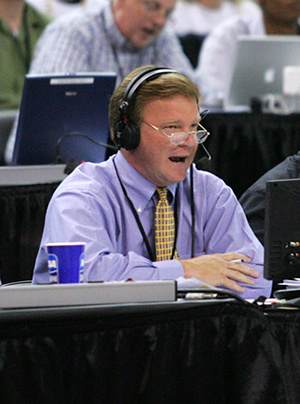
Joe Fisher, the Voice of the Commodores, responds to your “Ask a ‘Dore” questions submitted on VUcommodores.com earlier this month. Check back for part two later this week.
Who were some of the play-by-play annoucers that you listened to growing up, some of your inspirations? “Having grown up in Nashville, Paul Eells as the Vanderbilt announcer was an early inspiration. It was a blessing for me later to work for him and with him and count him as a friend. John Ward was also a tremendous influence at Tennessee, in terms of telling a story and painting a picture. Cawood Ledford was the consumate professional and unflappable on the air. I also followed closely Atlanta Braves broadcasts with Milo Hamilton and Ernie Johnson. Those were special days, sitting in the car or listening to the radio to pick up games from all over the country.”
Do you remember the first game you called for Vanderbilt. If so, what stands out? “My first Vanderbilt football broadcast was at Mississippi State in 1998. We were soundly throttled by the Bulldogs 42-0, and I remember thinking to myself “what have I gotten myself into”? I also remember on the charter flight home, one of the players turned around in his seat and asked me how my first broadcast went? I couldn’t believe anyone would even think to ask that after the day they had.”
If you weren’t doing play-by-play what would you be doing instead and is there a dream job that you had as a kid growing up? “Actually, I’m basically doing my dream job. I knew from junior high school (middle school these days) that I wanted to be a sports broadcaster. One of the toughest decisions I had to make career-wise was whether to take this job at Vanderbilt, or to keep my job as an account executive at the public relations firm of Dye, Van Mol and Lawrence here in Nashville. They are wonderful people who do amazing and exciting work. Over my three years there I was involved in a myriad of events, from the closing of Opryland theme park and creation of Opry Mills, to a presidential subcommittee on electric industry deregulation. It was challenging and exciting work, and if I wasn’t here, I would likely be there.”
Hi Joe- My 15 year old son wants to go into sports broadcasting as a career. Do you have any advice for him? Thanks and Go ‘Dores! “Well, I hope he doesn’t plan on making a lot of money! Seriously, the hardest thing to do is to get into the door. You have to be willing to work for little or nothing and do whatever it takes to get a chance for stations to see you are interested and committed. That means calling those who are in the business and asking for advice and help. You also have to be willing to go where the jobs are. I’m one of the rare folks in this business that was able to get a job and work in the city where I was born and raised.”
What is the most memorable Vanderbilt moment that you have commentated? “Wow, that’s a tough one. There are a few. The first one that comes to mind is Worth Scott’s two out, bottom of the 9th inning home run in to beat Tennessee on the final day of the 2003 regular season and put Vanderbilt into the SEC Tournament for the first time in years. For the sheer drama, it’s hard to beat. Of course, the VU football win at UT in 2005 ranks up there, as well as our comeback in the final minutes in Orlando to beat North Carolina State to advance to the Sweet 16. Honorable mention goes to the buzzer beater against Wichita State in the NIT, the win over Washington State last season, and the comeback in the SEC baseball tournament last year in Hoover.”
You seem to have no problem transitioning from Football to Basketball and Baseball. Which sport takes the most pre-show preperation and which sport is the most difficult to call? “Thanks for the kind words. The three sports are very different in preparation. Football takes the most time, simply because of the sheer numbers of players involved. Most people would think basketball would be the most difficult to call, but I actually feel that it is baseball. Basketball is fast paced with constant action, so you spend most of your time simply describing what is happening. Baseball is short bursts of action, with long periods of inactivity inbetween, so you have to be well prepared to fill those quiet periods for a successful broadcast.”
How much time do you spend before games that you call familiarizing yourself with the opposing team’s coaching staff, players, stats, etc.? Exactly, what type of preparations do you have to make? “This is my 10th year doing games at Vanderbilt, so I’ve gotten my preparation down to a pretty strict routine now. Normally, for a football broadcast, I’ll spend about 20 hours in preparation. This includes preparation of detailed depth charts, for two and three deep at each position, as well as culling down massive amounts of game note information on each team to items I want to make sure and use in the broadcast. It also includes production of pregame audio elements, such as coach and player interviews, as well as reviewing tape of previous games of our opponent. The other sports are a similar process, but not quite as time consuming. Baseball, actually, is the most hectic on game day, because starting lineups aren’t provided until a half hour or so before game time, so you can’t prepare your scorebook untl then.”
Traveling with the VU teams all the time, I’m sure you have some funny stories from the road. Tell us one of your favorites. “So many stories, so little time! One of my favorites was what started out as a nightmare when I was doing the Vanderbilt women’s games in the mid 90’s. We lost a game we shouldn’t have on a Friday night in Starkville. The team was scheduled to then fly by charter to Charlotte for a nationally televised game on Sunday afternoon with North Carolina State. However, a snow and ice storm hit the south. We were asked to meet the plane in Birmingham, but icy roads prevented us from going any farther that Tuscaloosa on Friday night. Saturday morning, we boarded the bus and headed for Birmingham, normally a one hour trip. Six hours later, we slid off the side of an exit ramp just outside of Birmingham. The entire state of Alabama was closed, and the TV network was worried we would not make it to Charlotte. Sunday morning, a charter plane landed in Birmingham somehow, though the airport was closed for all practical purposes. The ground crew dug one trench in the ice down the runway for the front wheel of the plane. We took off, landed in Charlotte and arrived at the arena one hour before tip off. No practice in two days. A hasty pregame meal of pasta was gulped down, and the Commodores proceeded to put a 20-point or so whipping on the nationally-ranked Wolfpack.”