
April 18, 2007
CHC- Joe Davis: Former Tennis Great (pdf) | CHC Archive
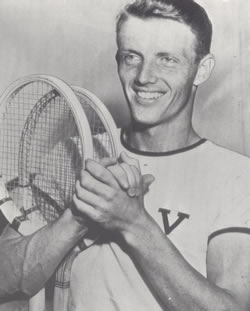
Joe Davis is arguably the greatest tennis player that has ever played on Vanderbilt’s campus. Davis’ three successive SEC tennis titles (1939-41) at the No. 1 position are unmatched in Commodore history.
 |
|
| Joe Davis |
Born in Cincinnati, Davis moved to Nashville with his family at an early age. MBA was where he prepped while becoming the Nashville city champion for three straight years (1935-37). While deciding on his collegiate choice, Tulane was very much an option after they had offered him a full scholarship. At the time, Tulane was a national tennis power and a member of the SEC.
Davis said in a 1985 interview in Go Gold, Inside Vanderbilt Sports by Harold Huggins, “Dr. Tom Zerfoss (of Vanderbilt) came to me in 1937, just two weeks before the start of school.
“He said Vanderbilt would give me a scholarship and books–and help me get a job to help out during the school year. I decided to take the offer and go to Vanderbilt for at least one year to see if I would like it. Then during my freshman year my father died, and that meant I had to stay close to home.”
The economics major played in an era where freshmen were ineligible for varsity competition. However, the following year Davis quickly became the star player for the Commodores. Davis also played for the Vanderbilt basketball team allowing himself to gain strength and stay in shape.
As the SEC champion, Davis automatically advanced to the individual national collegiate tennis tournament. During his sophomore and junior years, Davis lost to Bob Harmon of California in the middle portion of the competition. In Davis’ senior year, he only lost one conference match, which was to LSU’s Bernie Jacoby.
Davis would have a chance for revenge against Jacoby at the SEC tournament held on the Vanderbilt campus in the spring of 1941. Bob Steber of The Tennessean wrote about the Davis/Jacobs finals:
Joe Davis, who like Co. Bradley’s sensational Bimelech, lolls his tongue outside his mouth in the stress and strain of competition, almost had his Gallahadion yesterday. But it was “Gallihadion” Bernie Jacoby of LSU, who pulled up lame, nullifying any further parallel that might be drawn between the 1940 Kentucky Derby and yesterday’s Southeastern Conference tennis championship, played before 400 fans on the Vanderbilt varsity tennis courts.
Davis was almost “left at the post” as Jacoby poured a smooth-as-silk early shot stream at the Commodore, out steadying “Rock of Gibraltar” Joe to take a 6-0 first set triumph. He took the second too, 6-4, but the Commodore picked up momentum to run out the rest of the match 6-0, 6-0, 6-2 and win his third consecutive Southeastern Conference championship. That feat has never been equaled in the history of the loop. It may never be.
 |
|
The writer was making a comparison to Gallihadion the 1940 Kentucky Derby winner over favored Bimelech. Bimelech took the lead in that race, but was overtaken by Gallihadion. Competing in his third race in eight days slowed Bimelech.
Davis also was somewhat weakened when he began play in the tournament. He missed a month of playing time due to a bout with the mumps.
The Tennessean reported on the event that changed the match:
Jacoby purposely tossed off that last game, gambling for an “all-out” effort in the fourth designed to topple Davis off the throne he wanted so much to retain. But that chance never came, for with the score deadlocked at two-all in the fourth, Jacoby sent a stinging placement wide of Davis’ forehand and in the same motion fell writhing on the brick dust courts, griped in agonizing clutches of a leg cramp.
It took all of five minutes for Coach Charley Diel of the Tigers to message the limb into working order again. Although he treid courageously and at times hit the early-match peak, Jacoby was never the same thereafter. Davis ran out the set with four straight games and lost but few points in copping the clinching set by the same 6-2 score.
Jacoby’s cramp robbed the finals of much of their glamour. But it is doubtful if the ultimate outcome would have been reversed if the cramps hadn’t laid him low. Joe was playing too well and picking up poise and pace as he went along.
“I hate to win this way,” Davis said after the match. “But boy, it sure does feel good to win this title again in my last shot at it.”
During the national tournament in Philadelphia that year, Davis made it to the semi-finals. But he lost to Joe Hunt in three tough sets 3-6, 6-8 and 6-8. Hunt continued on to win the championship.
After graduating from Vanderbilt, Davis contemplated his future. Then the United States suddenly entered World War II. Davis enlisted in the Navy, and became a lieutenant while participating in the invasions of Sicily, Salerno and Normandy.
After his service duty was complete, Davis looked at his options. Davis said in the 1985 Go Gold interview:
“I decided I wanted to go into business and a man named Justin Potter offered me a job in the coal business right before the out break of the war. I started working January 1, 1945. I worked for Mr. Potter for about 10 years before I started into the business myself.
 |
|
“I was offered a job as a pro in a country club in Memphis, but after a lot of thought I turned it down. I realized that I’d never go any farther.”
Davis started his own company–Davis Coals, Inc in 1955. He turned the company into a successful coal mining operation in Kentucky. Davis was a member of the Vanderbilt Board of Trust, Montgomery Bell Academy Board if Trust and the Nashville Area Chamber of Commerce.
Davis became a member of the Tennessee Sports Hall of Fame in 1976 and died in 1989 of Hodgkin’s disease.
Davis said about Vanderbilt from his Go Gold interview:
“It’s a great school, with great people there, really first class people. So many have made great contribution to society. I think they have the right balance in sorts and schoolwork. That’s one thing that all student-athletes who come to Vanderbilt can be thankful for.”
Traughber’s Tidbit: Congratulations to Coach John Williamson and the Vanderbilt women’s bowling team by winning the NCAA National Championship last Saturday. By defeating Maryland Eastern-Shore, 4-3, the Commodores won the only team national championship in any sport in Vanderbilt’s athletics history. The 2001 women’s tennis team almost became the university’s first national champion, but lost in the finals. Vanderbilt becomes only the fourth bowling NCAA National Champion following Nebraska (2004), Nebraska (2005) and Fairleigh Dickinson (2006).
Next week read about former Vanderbilt baseball coach and Nashville Sounds first baseman George Weicker.
If you have any comments or suggestions, you can contact Bill Traughber via e-mail at WLTraughber@aol.com.