
Getting Women in Vanderbilt’s Game
by Mona FrederickThe Trailblazing Career of Stella Vaughn
Author’s Note
When I talk about the history of women at Vanderbilt and the role of Stella Vaughn in this history, this is the story of white women at Vanderbilt. The first African American woman to receive an undergraduate degree from Vanderbilt was Dorothy Wingfield Phillips who received her BA in 1967. The first black female basketball player at Vanderbilt was Teresa Lawrence Phillips when she joined the team in 1977. In 1979, Cathy Bender was the first African American woman to receive a basketball scholarship from Vanderbilt.
NASHVILLE, Tenn. — Stella Scott Vaughn was a trailblazer for equal educational opportunities for women. Born November 4, 1871, Miss Stella (as she was affectionately known throughout her adult life) came to live on the Vanderbilt campus with her family at the age of ten and remained unfailingly loyal to, although sometimes critical of, the institution for the rest of her life.
Stella’s father, Professor William J. Vaughn, was hired by Vanderbilt University in 1882 to fill the mathematics chair, one of eleven chairs in the “Academic Department,” now the College of Arts and Science. The Vaughn family (Professor William Vaughn, his wife Abby and their five children (Eugene, Robert, William, Harry, and Stella) lived for two years in Wesley Hall, a grand building in the center of campus that housed the Vanderbilt Biblical Department and library, 160 dorm rooms for professors and their families as well as students, some lecture halls, and a very popular cafeteria. In 1884, the family moved into their own residence on the campus and lived in this campus home for 28 years. In 1925, Stella Vaughn addressed the Vanderbilt Woman’s Club, recalling her early days as a child on the campus:
The latch string hung on the outside of our door, whose portals swung wide to faculty and students alike. When I was a little child, Bishop McTyeire used to take me by the hand and walk along the paths telling me the names of many of the trees whose growth he watched with keen interest.
Young Stella Vaughn received her early schooling with the other faculty members’ children in a one-room school on the western edge of the campus often referred to as “little Vanderbilt.” Stella was always very athletic and many referred to her as a tomboy. She liked to walk around the perimeter of the campus balanced on the tops of the board fences that surrounded the grounds; she also spent much time in her youth climbing the many campus trees. Stella said that “nothing went on above or below ground on the campus during my growing up that I did not witness.” In her handwritten notes from 1948 about growing up on campus, she mentions an encounter with a bricklayer in 1885 when she was about fourteen years old.
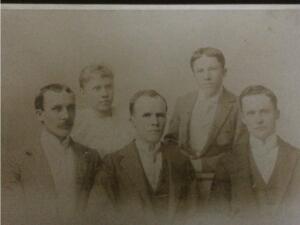
Stella Vaughn and her brothers: William, Eugene, Harry, and Robert. July 4th 1893
The first building enterprise on the campus after we came to Vanderbilt was the West Side Row dormitories, named by the students the “Home of the People.” Late one afternoon …. I was watching one of the men lay the brick in a chimney and I asked him if he would let me lay some of the bricks, he said, ‘you can’t get up here.’ Before he changed his mind, I was on top of the house. He turned over his trowel and mortar to me and I laid six bricks. He said that I could beat a squirrel climbing.
Stella Vaughn entered Vanderbilt University as a first year student in 1892, one of ten women in the Academic Department. (There were about 180 male students at the time.) Beginning that year, women were “admitted by courtesy” to the classes offered by the Academic Department. Although the women who were attending classes during this period were not allowed to matriculate, they could complete any of the degree programs offered, and were subject to the same rules as their male counterparts. During Stella’s days as a student at Vanderbilt, important changes regarding the status of women were underway. In 1894, the faculty voted 7 to 6 to allow women to compete for University prizes and awards. In 1895, a new record was set when three women graduated in one year. The year following Stella Vaughn’s graduation, the faculty voted to allow women the opportunity for formal matriculation. The women did not, however, have access to dormitories and lived in University-approved boarding houses near the campus.
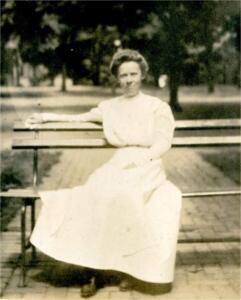
After her graduation in 1896, Miss Stella remained on the campus as the women’s physical education director, becoming Vanderbilt’s first female instructor. In the fall of 1896, Stella Vaughn organized Vanderbilt’s first women’s basketball team and served as coach, player, and team captain. What motivated Stella to teach the women to play basketball, a game invented only five years previously? Here we have to speculate.
In the fall of 1891, James Naismith famously invented the game of basketball. Enthusiasm for the game spread swiftly and by January 1892, the Physical Education journal The Triangle had published an article by Naismith about basketball. The winter sport quickly became part of the activities hosted by YMCAs across the country, including in Nashville. The first account of Vanderbilt men playing basketball was reported to have occurred on February 7, 1893. The Vanderbilt Hustler published the rules of the game in its December 21, 1893 edition.
Senda Berenson, the first woman enshrined in the Basketball Hall of Fame, began teaching women at Smith College in Massachusetts to play basketball in 1892 after reading Naismith’s article. Berenson, however, felt the game too rough for the women and she modified the rules so that the game would be both womanly and vigorous. She divided the court into three regions and prohibited players from leaving their assigned region. Players could not dribble more than three times, hold the ball for more than three seconds, or steal the ball away from an opponent (this would have been “unlady-like”). Just under a year later, the first inter-institutional women’s basketball game was held between the University of California Berkeley and Miss Head’s School. By 1895, hundreds of women’s teams were playing around the country.
The Division of Girls’ and Women’s Sports of the American Association for Health, Physical Education and Recreation urged Berenson to publish her modified rules. Berenson’s adapted game became the official rulebook for women athletes; in 1901, the Spalding Library published the rule book and continued to do so through 1919.
I imagine that Stella Vaughn, the young, new physical education instructor at Vanderbilt, was following the news of this novel game and the development of special rules for women. One of her first actions in her position was to teach the women at Vanderbilt to play basketball. However, her colleagues (all of whom were male), opposed Stella’s plans, as they felt girls playing basketball would stain the University’s name. Stella had a strong voice, though, and was able to strike a compromise: women could play, but men couldn’t watch (this was true on the several campuses around the country where women were playing basketball). In the first Vanderbilt women’s game, played March 13, 1897 against Ward’s Seminary (an all-women’s junior college in Nashville), a male reporter from the Vanderbilt student newspaper hid in the gym and his stealth reporting resulted in the following account of the game:
After the doors and windows had been barred and locked and a guard placed at each, time was called for the game to begin. ‘Now,’ I thought, ‘we will see some scratching and hair-pulling and hear half-a-dozen screams.’ I was not deceived; they showed that they were still girls.
The local Nashville newspaper, relying on other eye-witness accounts, wrote
The contest is said to have been one of spirit, evidenced by the sunny locks found on the floor later by the janitor. There were no broken bones, black eyes or scratched faces reported.
Samuel Anderson Weakley, a member of the men’s basketball teams of 1909 and 1910, later wrote an account that first women’s game: “The Vanderbilt team won by a score of 5 to 0 (a field goal counted five points in a girls’ game then). The game had gone 0 to 0 until just before the end, when Stella Vaughn threw a long pass to Elizabeth Buttorff near her goal and she in turn made a desperation throw at the goal.” Weakley goes on to state that Stella Vaughn should be “queen to reign hence forth” as Vanderbilt’s “Miss Basketball.”
Information is sketchy about the early years of the Vanderbilt women’s basketball program. Apparently, the women began playing a regular schedule in the early 1900s (some say 1902, others 1905). During this period, the doors were opened for women AND men to observe the games. After 1910, the women’s team travelled for away games against colleges in places such as Kentucky and Ohio. Reports about the games, including rosters and statistics, were regular features of the Vanderbilt student newspaper. In some accounts, the women’s team was referred to as the Commodoresses. By the late 1920s, reports on the women’s teams fade away, perhaps coinciding with Stella Vaughn’s stepping down from the position of head of physical education for the girls.
Around the time that Stella was penning her reminiscences of the early days of Vanderbilt’s history in 1948, plans were being developed for several new facilities on campus, including a new gym. She wrote:
Years ago, when I had charge of physical education for women I realized that we needed a new gymnasium. One day my girls told me that they didn’t know the rules in football and they wanted me to explain the game to them. I lined up two teams against each other and explained the duties of their respective positions. I called signals for my team and in a quarterback sneak, I started around the end of the opposing team, when I was tackled by Ann Scales. She went into me with such force that I slid across that pine floor for quite a distance. It took me some weeks to get all the splinters out of my body. You can understand why I am enthusiastic over the idea of an up-to-date gymnasium.
Stella Vaughn served as the women’s physical education instructor and basketball coach without pay for nine years. In 1905, Chancellor Kirkland proposed that Miss Stella receive an annual salary of $100 for her work with the female students. Eight years later (shortly after the death of her father), the Board of Trust voted to increase her salary to $200 per year. At the June 1913 meeting, Chancellor Kirkland stated:
I recommend that Miss Stella Vaughn be given $200 instead of $100 for her work with the young ladies. It is of great value to the young women studying at the University, and she has not measured her services by the time demanded of her according to her contract. She has not only taught them in the gymnasium, but has supervised their sports and in a general way has acted as advisor and friend.
Stella Vaughn’s accomplishments and those of her “girls” came not without struggle. As women garnered more academic honors during the early 1900s, questions about women’s proper role on the campus arose. In 1914, the women outpaced the men with an academic average of 81.72 percent compared to the men’s 71.47 percent. Women won the Founder’s Medal in the Academic Department each year from 1908 through 1912. Chancellor Kirkland continued to believe that coeducation was harmful to the institution, and hoped for a separate educational facility for women. “The girls at Vanderbilt have worked against the odds,” wrote Miss Stella at about this time, “but they are a ‘plucky bunch’ and not easily discouraged. They have slowly but surely won a place for themselves by their perseverance.”
In May 1915, a faculty committee led by English professor Edwin Mims examined a host of issues affecting the women students. The committee was favorably disposed toward the women, and Mims recommended appointing a Dean of Women and establishing a social center for the female students. However, at the urging of Mims, the committee also recommended the abolishment of all women’s intercollegiate athletics. Intramural sports and physical education were laudable, the committee wrote, but women’s competitive athletic contests were not in keeping with the “best tradition and practice of the entire country.” The faculty tabled this recommendation and Vaughn’s teams continued to compete against other colleges.
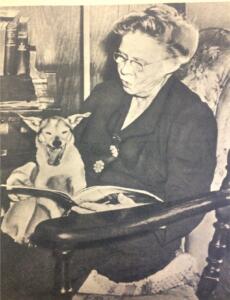
In addition to her role as physical education instructor, Stella Vaughn’s 11-room home at 2122 Highland Avenue, built for her by her brother Harry around 1915, was one of the approved boarding houses for the female students. For more than thirty years, Vanderbilt boarders were a part of her home. She often tutored students in French and German. When her contemporaries would complain about the young people of the day, Stella was quick to rise to their defense. “You are very much mistaken. Customs change. Character never does. You have to stay in step with youth to understand that.”
Stella Vaughn died in October 1960, a few weeks short of her eighty-ninth birthday; Vanderbilt University had been at the center of her interests for seventy-eight years. Once asked about her relationship to the University, she replied, “This campus life is a very great privilege. It’s the life of me.” The Nashville Banner reported, “Miss Stella Scott Vaughn, the grand old lady of Vanderbilt University, is gone.” In 1963, the University named one of the four new women’s dormitories in the Margaret and Harvie Branscomb Quadrangle the Stella Vaughn House. In 2015, 119 years after she first accepted the position of unpaid physical education instructor at Vanderbilt, Stella Scott Vaughn was enshrined in the Vanderbilt Athletics Hall of Fame.
May her spirit continue to haunt our campus.
Mona Frederick is the former executive director of Vanderbilt’s Robert Penn Warren Center for the Humanities.
About the Anchored for Her Campaign
Through Anchored for Her, Vanderbilt’s comprehensive fundraising campaign, the university is positioning volleyball and its broader women’s athletics programs as national leaders in advancing women’s sports. Anchored for Her’s initial $50 million goal will fuel investment in sustainable success for a new era of collegiate athletics through facility enhancements, endowed scholarships, coaching and staff positions, capital support and naming opportunities, team-specific Excellence Funds, the Women’s Athletics General Fund and the Competitive Excellence Fund.