
Jan. 7, 2015
By Jerome Boettcher | Subscribe to Commodore Nation
If anyone understands how important a new training room is to the Vanderbilt athletic department, it would be Jill Kispert.
Though she didn’t suffer any major injuries, ankle sprains frequently slowed the two-sport athlete. When not on the basketball court and soccer field, Kispert – formerly Jill Goldberg – spent many hours in the training room from 1986-89.
“So much of that (college) experience included the training facilities and the people in them and the staff, which really helped complete the positive experience I had,” Kispert said. “You don’t always want to be in there but… I have a lot of memories in that room.”
So, for Kispert, a 1989 Vanderbilt graduate, lending financial support to see the new training room come to fruition was an easy decision to make. The California resident wanted to give back to an area that helped her heal quickly.
“This was one that was near and dear,” she said. “I always appreciated the people that paid it forward for me in my experience. I was glad to do the same for this next generation of athletes.”
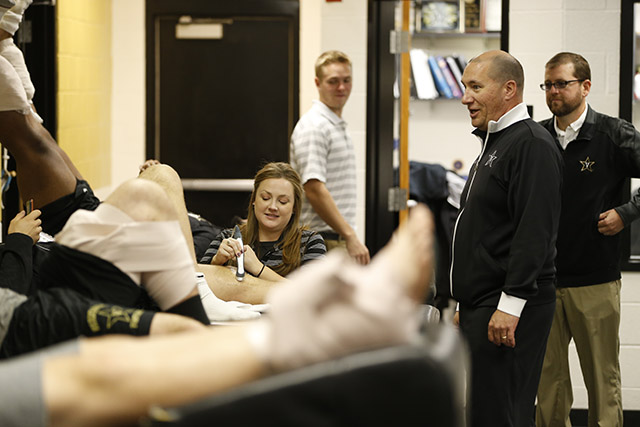
Now, because of the generous support of donors, the training room is getting a much-needed facelift. Head athletic trainer Tom Bossung and his staff moved out in early December and across the street to a temporary home in the basement of Memorial Gymnasium as construction began for the McGugin Center training room.
The new facility will serve all 350 student-athletes and span more than 9,200 square feet. It will include dietary, examination and treatment rooms, a conference room, two team doctor offices, new office space for Vanderbilt’s 13 athletic trainers and a welcoming student-athlete entrance and lobby. It will also include three hydrotherapy pools and modernized equipment (such as an underwater treadmill) as well as more treatment tables, taping stations and cardio equipment and two rooms designated solely for private physician examinations.
“The training room project is going to be a great addition to our facilities,” women’s basketball coach Melanie Balcomb said. “And it will have a positive impact on every team on campus. It will also put us along side the best facilities in the SEC and the nation.”
Orion Construction will begin mobilizing and setting up perimeter fencing in January. In February, excavation and demolition work starts, as the entire process will take eight to nine months. Bob Grummon, who is an architect with Vanderbilt Campus Planning and Construction, said the training room is expected to be completed in the fall semester.
Bossung first arrived at Vanderbilt in 1990 as a graduate assistant and was in awe of a brand new training room, which had been built in 1989 and featured a state-of-the-art therapeutic eight-foot deep swimming pool.
But, since then, he notes the significant changes that have increased the need for more space  the addition of several varsity sports, his staff doubling, team roster sizes expanding and the NCAA allowing extra practice hours in the off-season. Bossung estimates during the peak times of the fall and spring that nearly 200 student-athletes visit the training room in the course of a day.
“It should allow us to be more efficient with what we do,” Bossung said. “My appreciation to those who have contributed to it. I understand a lot of times people want to give and they want to give to a certain team. That is the biggest thing – we affect all of those kids. So in a sense you are giving to those teams, it is just not one team exclusive. It is the entire population of our student-athletes. I certainly thank and appreciate those willing to contribute.”
Johnny Johnson, one of the project’s lead supporters, credited university leaders for placing a strong emphasis on the project.
The 1968 Vanderbilt graduate played on the freshman baseball team and also golfed for the Commodores. He remembers dressing for baseball games in a crammed Parmer Fieldhouse. He believes a commitment to building a state-of-the-art training room goes a long way.
“This is by no means a capstone but it is certainly a very significant milestone,” he said. “The project is extremely important to advance the progress that has been made in the world of collegiate athletics and Vanderbilt being competitive in that world.”
Director of Athletics David Williams knows this project wouldn’t have happened without the generosity of donors who care about Vanderbilt athletics.
Williams reiterated Bossung’s thoughts and said this project touched all sports, which appealed to many donors.
“From a health point of view and a performance point of view it helps our student-athletes, which then helps everybody,” Williams said. “What everyone could give they were giving because they saw the importance of it. We have to raise money for a lot of the things we do. I’m just thankful we continue to have a very strong cadre of people out there that allow us to come talk to them about it, can understand and see it and give money.”