
Sept. 23, 2015
By Jerome Boettcher | Subscribe to Commodore Nation
Classic cars.
David Williams wasn’t sure what to expect heading into his trip to Cuba in July, but Vanderbilt’s athletics director knew he could count on seeing vintage American cars from five decades ago.
Williams was in high school when the Cuban Missile Crisis unfolded and when the United States placed an embargo on the island country in 1961. So information out of Cuba was scarce and thus left many unknowns for Americans.
“Everything after that, what I knew about Cuba, was what we had been told,” Williams said. “The only thing I knew I was there were a lot of old cars. I knew they had not been able to have new, American cars in. So I expected to see old American cars and you could see that a lot.”
How Cuban people felt toward Americans, however, Williams was uncertain of.
Fifty-four years had passed since the U.S. Embassy closed its doors in Havana and diplomatic and economic relations ceased between the countries. But Williams didn’t sense disdain or vitriol from Cubans toward American tourists.
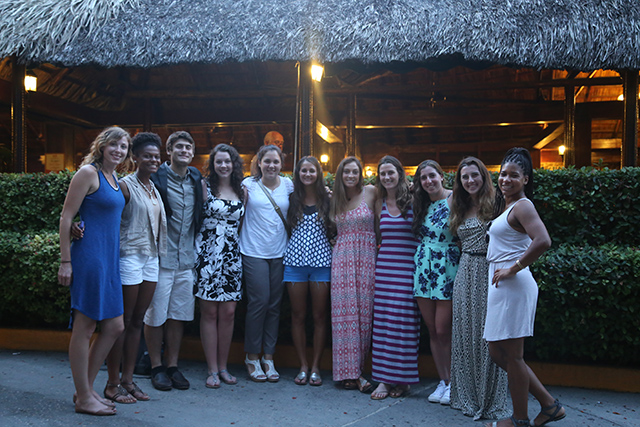
No, instead, when Williams, 10 Commodore student-athletes and two staff members partnered with Nashville-based non-profit Soles4Souls for an international service trip to Havana and Trinidad for a week at the end of July, the group was welcomed by friendly, jubilant, passionate Cubans.
“I thought because of our (countries’) relationship, (Cubans) will probably not be that fond of Americans,” he said. “And I was totally wrong. They were very, very, very pro-American people. What had been in my mind was we put an embargo on this country; they are going to blame whatever woes they have on us. I didn’t sense that at all…. Their treatment of Americans – at least for us – was overwhelmingly positive.
“I didn’t see a lot of people who were like, ‘Man, we’re depressed and we’re unhappy.’ I saw a lot of people who loved their music, loved their dancing and were happy to have tourists.”
The Commodores visited Cuba during a historic week. On July 1, President Obama announced the two countries agreed to open embassies in each other’s capitals on July 20 – officially resuming full diplomatic relations. The Vanderbilt contingency arrived in Havana the day before, then visited the U.S. Embassy and was a part of the first official briefing on July 21.
Along with Williams, 10 members from seven sports made the trip – Simone Charley (soccer/track), Logan Cox (soccer), Sam DeFabrizio (men’s cross country), Kendyll Dellinger (bowling), Ashlin Dolan (lacrosse), Kate Hornaday (swimming), Alexa Kunowsky (lacrosse), Nicole Powell (bowling), Morgan Ransom (women’s golf) and Georgina Sellyn (women’s tennis).
The trip marked the third time Vanderbilt’s athletic department partnered with Soles4Souls to distribute shoes to children and families in need. More than 20 Commodores first went to Tanzania, Africa in 2013, then another 13 ventured to Costa Rica in December 2014.
While more than 750 pairs of shoes were handed out to the children of Cuba, this trip proved different than the previous two due to the significance of the visit. Americans hadn’t been allowed to visit Cuba for nearly 60 years. So not only was service a key component of the group’s visit, but much more emphasis was placed on the cultural and educational elements.
“It was an awesome opportunity,” Charley said. “Being able to make a difference in handing out the shoes to all the different children as well as experiencing the history that has been shielded from Americans for so long. It was awesome being able to learn from the culture and history but also give back to the people who needed it.”
A professor at the University of Havana spoke about relations between the U.S. and Cuba. Another professor at the university discussed the country’s economic transformation process. They toured the UNESCO World Heritage Sites in Old Havana and Trinidad. They swam in the San Juan River cascades. In Havana, they stayed in the Hotel Riviera, which was portrayed in Godfather II, and a property Williams could tell was glamorous back in its heyday.
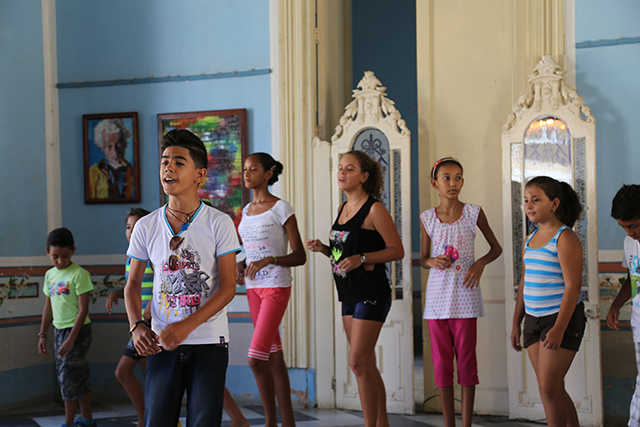
On the way to Trinidad, the group visited Cienfuegos City, which was settled by French immigrants from Bordeaux and Louisiana in 1819, and toured the Palacio de Valle. In Trinidad, they visited with students and art instructors at Casa de la Cultura while also distributing shoes.
“It is a fascinating place. To be 93 miles from Miami, it is a very different world.” Williams said. “You still are at a situation where there are statues and billboards and sculptures and pictures of Che (Guevera) and Fidel (Castro). And right in the middle of that, there may be a statue of (Abraham) Lincoln. It’s like, ‘Man, you guys didn’t tear those down?’ To them, to the people, I don’t think they ever saw us as an enemy. If you talk to enough of them that want to talk about it, they still even talk about the United States’ assistance in getting their freedom from Spain.”
While Williams remembers vividly the Bay of Pigs Invasion, Charley and her peers were unfamiliar with much of the tension between Cuba and the United States. Through their discussions with diplomats, professors and Cuban citizens, the group received a vantage point unlike any they’ve read in a textbook. At the same time, when they visited the U.S. Embassy, they received the American point of view. They also were surprised to learn while diplomatic relations ceased between the countries, Americans were still working out of the Embassy building for nearly four decades. In 1977, the United States Interests Section of the Embassy of Switzerland in Havana opened and was staffed by United States Foreign Service personnel. That branch was abolished when the U.S. Embassy reopened in July.
“It was interesting getting this whole section of history that I was like, ‘Where has this been?'” Charley said. “There was a gap in our history so it was cool being able to bridge it all together.”
A distinction in class wasn’t apparent, as the group was only told that wealthy Cubans live in West Havana, though they never saw that area. Many of the buildings looked their age. Hotels off the Caribbean Sea, in Williams’ opinion, need to be touched up and have necessary updates like air conditioning in the lobby, if tourism hopes to boom with the door being open to Americans. But Williams also said there is hesitation to privately invest in commercial real estate in Cuba, since the government claims at least 51 percent of the profit.
He also found it interesting that the country is run by the Communist Party, Cuban people were adamant that they’re a socialist country.
“Who am I to argue with them?” Williams said. “The great thing about this is, and I told some of the students this, I don’t know what is real and not real. But what you now have is you have a different story than what we heard.”
Aside from the cultural and educational lessons learned, the group relished the opportunity to impact the local Cuban community. They distributed more the shoes, decorating the footwear and chatting and playing with the children through broken Spanish and body language. They also connected through fútbol as soccer teammates Charley and Cox played pickup games every day with neighborhood children. And, as was the case with the previous two trips, traveling to a new country and engaging in a selfless act brought the Commodores closer to their peers – many of whom they hadn’t said more than a handful of words to in the past. But the historic trip served as a springboard for unique friendships.
“It is crazy to think all those people who were in the group, they have been here the whole time,” Charley said. “We never would have crossed paths and figured out how great they were and how much we had in common if it wasn’t for this awesome opportunity Vanderbilt has once again provided. I’m so incredibly thankful for the opportunities I’ve been blessed here with (at Vanderbilt).”
Recounting a week in Cuba
Rising sophomore Sam DeFabrizio was one of 10 student-athletes who ventured to Cuba with Soles4Souls in July. DeFabrizio, a native of Gen Gardner, N.J., shared his thoughts from the week-long trip to a country that has been off limits to Americans for more than 50 years.
Since returning I’ve fielded a lot of questions about Cuba. Most have been along the lines of “What was it like?” or “Why were you there?” The more adventurous questioners asked if the Cubans hated us or if we were the only tourists. In trying to answer these inquiries I found myself asking more questions than anyone else. However, I should probably address the most common questions first.
Cuba is a beautiful country with picturesque beaches, inviting people, and a fierce love for culture. As a part of Vanderbilt athletics’ mission, we were able to provide shoes to a number of children (service thanks to the NGO Soles4Souls) and be introduced to the intricacies of the economic and political situation of Cuba by leading professors. No, the Cubans did not hate us; I saw more Cubans wearing American flags than Che Guevara T-shirts. We were not the only tourists either. Besides a few American groups, Cuba is filled with tourists from Europe and Canada, and a large part of the economy is based around tourism. Besides the explanation of why we were there, we took part (a small part, albeit) in a historical moment  the re-opening of the U.S. Embassy in Havana for the first time in nearly 60 years  that is just the beginning of the normalization of relations between two once-opposed nations.
Cuba filled me with questions about how our relationship with the island nation will evolve over the next decade. Cuba will undoubtedly be a destination for many Americans due to its attractions, culture, and ‘uniqueness.’ The Cubans are also in a position to become a larger part of the global economy; I found them to be highly educated, driven, and resourceful. A prime (and likely overused) example is their diligence and ingenuity in keeping 1950s American cars on the road. As I’ve said to a few of my friends, these people are poised to make a big impact on the rest of the world.
Normalization will bring Internet availability to Cuba more rapidly than otherwise would have occurred. The Cubans will have more inspiration to open privately owned restaurants, start businesses, and find jobs that will have overlap with American companies. Likewise, many will want to invest in Cuba despite having to share ownership of some businesses with the government. How will American corporations handle entering a new market? Will there be apprehension or exuberance? Will a capitalist business model survive in a socialist country?
Moving away from the questions I have, I’d like to talk about the most valuable part of our experience. I know it sounds cheesy, but being able to travel alongside my fellow Commodores and student-athletes was the best part of the trip. I was the only male athlete in the group, but I found myself surrounded by inviting individuals who included me as a brother. We grew close despite barely knowing each other, and passed the 5-hour long bus rides engaged in conversations about each other’s sports, majors, and personal lives.
There was a shared uneasiness about the unfamiliar environment that allowed us to bond not as soccer players or tennis champions or bowlers, but as global citizens. Although the mission of these trips is to make the lives of those around us better, I think the best part about the service opportunities that Vanderbilt athletics offers abroad can be found in the community it builds at home.