
July 27, 2015
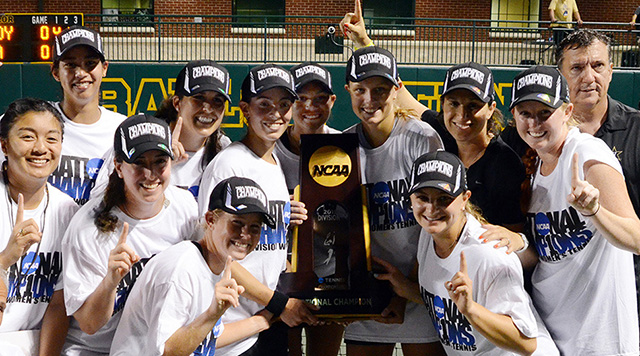
In his 21st year at the helm, Vanderbilt’s longest tenured coach in any sport, Geoff Macdonald, led the Commodores to their first women’s tennis national championship in May. Macdonald, who was named the ITA National Coach of the Year and SEC Coach of the Year, reflected on winning a national championship, the makeup of this historic team and coaching for nearly three decades.
Commodore Nation: What memories stand out from winning the national championship?
Geoff Macdonald: Every one of (the players) did something. I look back on it and there are a lot of matches where every player on the team had a win (in the NCAA Tournament). The national championship was like that. There were so many unsung (players). We were such a good team. I keep reflecting on the lack of nerves of all the players and coaches. I don’t know about Vandy fans watching, (but) I felt a really solid belief. I did not ever go out to the outcome. I kept trying to do what was the right thing to do that moment.
Commodore Nation: What was that moment like when Astra Sharma clinched the national title?
Geoff Macdonald: Marie (Casares) was playing. She was up break point to go up 4-3. We tell them don’t look around – really focus. So I was really trying to take care of Marie. But I turned around and saw Astra and (assistant coach Aleke Tsoubanos raise their arms). So I walked out in the middle of the point. You stop the match anyway but usually you wait until the end of the point. I just walked out to Marie and said, ‘Stop, stop, stop.’ I just walked into the middle of the match, which you never do. I’ve never done that in my life. And I just looked at Marie and I said, ‘Marie we just won the national championship.’ Just like that, sort of matter of factly. And then I gave her a big hug. Then immediately you want to find UCLA’s staff. I went to (head coach) Stella (Sampras Webster) and she was just classy and gracious. Marie and I were a few courts over so she ran over. But I just shook Stella’s hand and the assistant (Rance Brown’s hand) and walked over. I felt really good but kind of, ‘What just happened?’ I wasn’t jumping up and down. If you look at the press conference after it, it is striking to me that we’re obviously happy but we weren’t giddy or silly. Especially Astra and Marie, they were so articulate and calm.
Commodore Nation: Why do you think your team was so calm, and not overwhelmed by the gravity of the moment throughout the NCAA Tournament?
Geoff Macdonald: If I could bottle it and sell it I’d be rich. There was a lot of stuff we did. One, we were 4-4 (on Feb. 15) and we were meeting up at LAX. You don’t want a team to get battle shy. So we said we’re a teaching culture, not a blame culture. We win and lose as a team. Gosh, the guts it takes to be the last one out there. And we said everybody is going to be in that position and we’re going to have to be fit. You don’t want to lose that because you didn’t do the work. And you want to be calm. I heard (baseball coach Tim) Corbin say he likes players with low heartbeats. We worked a lot on mental stuff, like breathing, looking at things in the right way. I think there was a really interesting feeling of improvement. We’re genuinely better now than we were. When we played Florida here and beat them I think the team knew they could do it and obviously did it. But that is when they were elated. It is like you can do this. You can play at this level day in, day out. You don’t have to do more but just keep working on your game.
Commodore Nation: For you, was this a culmination of what you’ve built here in 21 years?
Geoff Macdonald: We got to the finals in 2001, Final Four in 2004 and then 11 years later to win it is pretty neat in terms of being able to be back up a high level. It’s difficult to do. The neat thing in this job is you can keep growing, you can keep learning all the time. So it’s never boring. You’re dealing with young people at a really fascinating time in their lives. They’re trying to do all this stuff. You’re juggling and balancing all these factors. It is a very interesting job. The neat thing is the relationships on the team we’re really good, one through 10. My relationship with the players, and Aleke’s and everyone’s relationships were good. Then the tennis part was fascinating. I had a coach say I watched five hours and I don’t think I saw bad decisions more than a handful of times. We were playing the game really well. As a coach that is so gratifying because it is the hardest game ever invented, no doubt. You’re moving, the racquet is moving and the ball is moving. You have to be unbelievably good mentally, you have to be really good physically and you have to be really good emotionally. You are out there by yourself. Then the counterintuitive thing is it is a team. So it was wonderful. I call it the most prolonged peak experience I’ll ever had.
Commodore Nation: Did you think you would be at Vanderbilt 21 years?
Geoff Macdonald: You know it’s funny, I was three years at LSU, three years at Duke and when I was three years here I kept looking for a moving van. I guess I move every three years. So no but when I came here, I thought the potential here is phenomenal. It really is. The values are good. But that means our margin, we have to be really, really careful. They have to be able to do the schoolwork. That is the first hurdle. I say to people all the time do you want to go to one of the best institutions in the world academically and then do you want to play basically professional tennis? For the right person, I basically described heaven. We really like to develop players some potential in that is a better formula for us.
Commodore Nation: Was coaching always the goal for you?
Geoff Macdonald: No. I majored in English at Virginia. And I was getting a master’s at the University of Florida in fiction writing. And we had our first child and my wife got a job at UMass-Amherst. I wanted to get a Ph.D. and I thought it would be cool to be Division III, a small school and be a professor who maybe coached a little. I thought it would be neat to do both. We moved to LSU (for his wife’s job) and by absolute coincidence they had a women’s job open up… When I first coached at LSU I had friends call me and say, ‘What are you doing?’ They were lawyers and they were in the corporate world. A few years later they said, ‘Now I know why you are doing what you’re doing.’ I go to work in shorts. You travel around. It is competitive. It is a hard job. You travel. There is a lot of heartache. You’re putting yourself on the line a lot of times a year. But it has been a really fascinating way to make a living and I’m lucky to be here.