
Oct. 21, 2015
Commodore History Corner Archive
When former Commodore strong safety Jay Chesley (1972, 1974-75) was considering college football offers out of high school, he was already familiar with Vanderbilt due to his two older brothers. Also wearing the Black and Gold football uniforms were Curt (1968-70) and Gary (1969, 1971-72).
All three brothers were recruited by Vanderbilt head coach Bill Pace (1967-72). Chesley, a Alexandria, Va., native, also considered the Ivy League schools, Florida, Tennessee, Georgia Tech and Virginia. The Cavaliers attended his high school practices nearly everyday, but “good or bad, I had made up my mind I was going to Vanderbilt,” said Chesley.
When Chesley enrolled at Vanderbilt in the fall of 1971, freshmen were ineligible for varsity play. Chesley did play on the freshman team that played a five-game schedule. He did not start any games as a sophomore, but did record one interception.
“I did not play much, but I learned a lot from watching Doug Nettles who would play in the NFL for Baltimore,” said Chesley about his first varsity season. “I played corner that year. When we played at Tampa, they had John Matusak who was head and shoulders above the rest of his team. His arms were huge. He was a pretty intimidating guy. Matusak became the NFL’s No. 1 selection in the draft (1973). I did have my first interception that year and was tackled to the turf on my helmet.
“I might have had a concussion. There was no concussion protocol then. I had to watch game film because I couldn’t remember making the pick at the time. Bobby Proctor was my secondary coach and taught me a lot and encouraged me. He left for Oklahoma after the spring semester in 1973. In the spring game I started to come out on my own. I had three picks and was figuring it out at that point.”
Pace was replaced by 28-year old Steve Sloan after the 1972 season. Chesley sat out the 1973 season and went back to Virginia to work.
“It was a little bit of a culture shock for me,” he said. “I was immature. I hadn’t really led a sheltered life, but I have no excuses; it was all on me. I didn’t go to classes like I should have.”
What about the coaching change from Pace to Sloan?
“Bill Pace was the head coach when I came there,” said Chesley. “He recruited Gary and Curt also. I really liked Pace. Charlie Bradshaw, the defensive line coach, made a lot of the decisions that maybe Pace should have made. Pace was a great offensive coordinator.
“Steve Sloan was the breath of fresh air that Vanderbilt needed. He turned the program around in two years. That’s when Bill Parcells (defensive coordinator) came in with a lot of fresh blood. We had great coaches. I can’t put my finger on why Sloan was so successful at Vanderbilt.
“It is one of those intangibles like when Parcells was there. Something just clicked. You always thought Parcells had your back. If you were in a dark alley and in trouble he would help you.”
Parcells later became a two-time Super Bowl winning head coach with the Giants and a member of the Pro Football Hall of Fame in Canton, Ohio. Chesley has a lot of fond memories of Parcells.
“One is a good story, and one is a bad story,” said Chesley. “The bad story is for cutting class I had to run the stadium steps with five or six other guys at six o’clock in the morning, which is a refection of my bad mentality when it came to getting an education at the time. We would run all the way to the top and back down.
“All the other guys were throwing up and nearly passed out. Me and one other fellow were in great shape and as fresh as could be so Parcells started laughing and said to get the hell out of there. He thought it was funny that we were in such incredible shape and could have run them all day.
“One day in practice we were running 7-on-7 and it was live. I popped one of the running backs that came out on a swing pass and he had a hard time getting up. The offensive backs’ coach said, ‘your guys don’t need to be hitting our guys on purpose like that.’ And Parcells said, ‘if they can’t take it, take them off the field.’ He had your back.”
Sloan’s team was 5-6 in his first season with victories over UT-Chattanooga, Virginia, William & Mary, Georgia and Tampa. The next year, 1974, was historic for Vanderbilt as it appeared in the university’s second bowl since the 1955 Gator Bowl. After a 7-3-1 season, the Commodores were headed to Atlanta for the Peach Bowl against Texas Tech. Chesley was recognized as First Team All-SEC that season.
“As far as what I accomplished it goes back to Bobby Proctor, “Chesley said. “I played offense and defense in high school like most guys at the time. In the latter part of my freshman year they switched me to defense. Proctor provided me with inspiration. He pulled me off to the side of practice one day and told me I’d be a great player if I kept working hard. I never forgot that. I just channeled things into that mentality.
“Of course, back then it was see how hard you can hit the other guy to keep him from getting off the turf. We were a cohesive unit on defense. When we would practice the offense was the enemy. It was great from a player’s standpoint. We didn’t like the offense during the week, but we were bound together as a team when it was game time. We were all one cohesive team. That intangible that Sloan, Parcells and the staff brought out came together fairly well.”
In that season Chesley had five interceptions for 121 yards and two touchdowns. The pair of six-pointers in a single season was a Commodore record tied by Trey Wilson who ran back two interceptions for touchdowns in 2011 and 2012. Chesley did not consider himself a “ball hawk.”
“People did put that tag on me,” said Chesley. “It was not exclusive to me. I was a hustler. Quickness was one of my assets; I wasn’t super fast. But if there was anyway I could get around the ball before the whistle blew that’s what I would do. The interception against Ole Miss (66-yard TD) is one I can’t take credit.
“There was defensive pressure from the line on the quarterback who was rolling out and going down. He threw it right to me. The other one was an overthrow late in the game. We were in two-deep coverage and I just happened to catch the ball that hit me right in the chest.
“The year 1974 is the year I remember the best. I played better games and we played against better teams. Florida came in ranked No. 8 and our offense turned it over five times and we still beat them.”
One disappointing game that season for Commodore fans was against Tennessee on Dudley Field. The Commodores were leading 21-13 late in the fourth quarter with Vanderbilt punter Barry Burton standing inside the 10-yard line. Burton dropped the snap and UT had the ball inside the Vandy 10-yard line. The Vols would score and add a two-point conversion to knot the final score at 21-21.
“The play they ran for the touchdown was a sweep to our left defensive side by Stanley Morgan,” Chesley said. “It was soaking wet and in the 40’s and a terrible day to play as far as game conditions. If I had to look back at that game being my last I would be sick to this day.
“After they made the two-point conversion there was a UT guy punching me in the face, mad, and I hadn’t done anything. They didn’t throw a flag. We all took that loss personally and we were not happy. We got revenge in my senior year, which is what I like to remember about UT.”
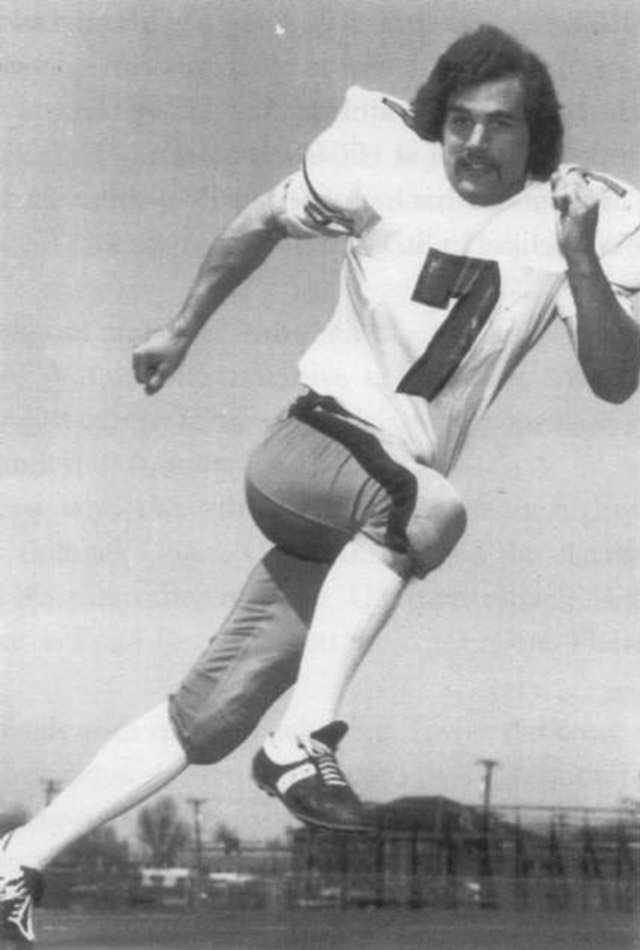
Vanderbilt would tie Texas Tech 6-6 in the Peach Bowl with each team scoring two field goals. Chesley did record one interception for a 41-yard return that set up the Commodores’ first field goal. While in the red zone just before the first half ended, Texas Tech was stopped by the Vanderbilt defense ending with a fourth-and-goal at the goal line.
“Ed Oaks, our free safety from Cullman, Alabama, was not that big and was tough as nails,” said Chesley. “He was an example of a football player. He didn’t get much notoriety, but at the goal line on fourth down their running back’s helmet hit Ed right in his chest and Ed stopped him cold.
“That was the mentality of that team. That cohesive strength you get when players like Ed Oaks step up. Just like the Tennessee game in 1975, he got two interceptions and played an awesome game, but you never heard much about Ed Oaks the safety. It took all of us to have those victories.
“On my interception I was on the tight end and the quarterback threw a bad pass right to me. It wasn’t any stellar play on my behalf. All I had to do was catch it and run the other way.”
The big news days after the Peach Bowl tie, Sloan announced that he was leaving Vanderbilt for Texas Tech whose coach left for the open South Carolina position.
“The one thing that Sloan and the staff left for us was is we knew we could win and that carried over,” Chesley said. “Sloan had a connection with all the players whether you were the star quarterback or a third-teamer. We hated to see him leave, but nobody hung their head and said this is the end. He brought us together as a team and taught us how to win. We would have won no matter who replaced Sloan.”
Fred Pancoast from Memphis State was hired to replace Sloan. Chesley said it did not affect him to have three coaches in four years. Chesley said that he and Pancoast did not get along believing it was a “personality thing.”
Vanderbilt was 7-4 in Chesley’s senior year winning the final four games over Virginia, Kentucky, Army and Tennessee. The Commodores were left out of a bowl invitation since all the bowl games were taken after the four-game, season ending win streak. Chesley was named for the second year First Team All-SEC with three interceptions.
The final game of the season was a victory over the Vols in Knoxville, 17-14. Late in that game Burton was in a similar punting situation from the previous year with Vanderbilt leading 17-14 late in the fourth quarter. This time, Burton got the kick off and Vanderbilt held on for the win. The win was the first for the Commodores in Knoxville in 30 years.
“Beating UT in Knoxville was good enough for me as far as that season,” said Chesley. “When Barry lined up for that last punt we were all thinking ‘oh hell, here we go again.’ I went back to 1965 when my older brother went to Vanderbilt and he didn’t like Tennessee and I didn’t know why. I learned it from him, which was 10 years in the making of not liking Tennessee Orange. I remember once when a Tennessee player grabbing my neck under the pile. That is the way I like to play football. If you want to get nasty so can I.”
Chesley led the Commodores in punt returns for both 1974 (10.3 average on 12 returns) and 1975 (7.1 average on 25 returns). The six-foot, 180-pounder was selected to play in the annual Senior Bowl.
“I didn’t play that much,” Chesley said. “We practiced for a week and had the Bears staff with Jack Pardee as coaches. There were a lot of scouts there. I didn’t do anything good or bad. I was out there for a handful of plays. It was the practices and scrimmages that got you noticed. I received a small paycheck for losing the game.
“I don’t have any regrets about anything like the decisions that I made. I can’t go back and change anything I did. I had the opportunity to play in the Blue/Gray game, but didn’t. There was another game where the best of the college players played against the NFL champions.
“The college team played the Steelers that year. And I chose not to play. That may have been a good idea since Lynn Swann was the wide receiver for the Steelers and he would have made me look like I shouldn’t have been on the field in a uniform.”
Chesley was selected in the seventh round of the 1976 NFL draft by the San Francisco 49ers. Monte Clark was in his first season as the 49ers head coach. The team finished 8-6 that season.
“I was expecting to be drafted,” said Chesley. “I believe if I had been more socially in line I probably would have gone higher. I was fortunate to have the opportunity with the 49ers. It was what I wanted to do. I believe the 49ers had traded away their first round pick and Randy Cross from UCLA was technically their first selection.
“Randy was rooming across from me in training camp. His signing bonus was something like $80,000. When you look today that disparaging number might be $6 million or $8 million. It is amusing. I got to be around guys that were veteran players that was an experience for me.
“College has some great athletes, but the NFL is a totally different ball game. I remember doing the vertical jump behind Delvin Williams (RB) where he jumped 42 inches. I think I got all of 28 inches. I realized I couldn’t jump like these other players could.”
Chesley did not make the 49ers final squad, but had a chance on another team.
“One night Randy Cross and I ate dinner together,” said Chesley. “We were laughing about how they would send an assistant to your room and to say. ‘Coach wants to see you, and bring your playbook,’ which means you are out of here. Sure enough the next morning they woke me up out of a dead sleep and told me to see the coach.
“I was told I was on the roster, but they were working on a trade and I couldn’t practice. They said they’d fly me home or I could hang around there until the trade was worked out.
“They worked out a trade with the Seahawks, which was the perfect scenario. Seattle was an expansion team. I got up there and was put on the third team. I didn’t feel I was getting a fair shake. But I wasn’t up there for very long, so I just ended up leaving camp.”
For the past 20 years Chesley has been in the real estate business once moving from Watertown, Tenn., to Apalachicola, Fla., where he presently lives. Said, Chesley, “We have a good life here; we work, do real estate, fish and scallop.”
Chesley was asked to reflect on his time at Vanderbilt as a former Commodore football player.
“Selfishly speaking, I was given some God-given ability,” said Chesley. “I was at least smart enough to use that ability to make a difference on the field. I was proud that I was First Team All-SEC selection for two years. Most importantly, I was proud that all us came together while being recruited by different coaches. We got out there and kicked some butt. Obviously we lost some games, but we did pretty dog-gone good at Vanderbilt.”
Traughber’s Tidbit: Vanderbilt has had three brothers play on the football team at the same time. In 1906, Bob and Vaughn Blake played ends while Dan Blake was a halfback. Dan was captain in 1906, Bob in 1907 and Vaughn in 1908. All three made the All-Southern team. A fourth brother, V. Weldon Blake, was a member of the 1903 team.
Tidbit Two: This Saturday the game against Missouri is Vanderbilt’s homecoming. In the years prior to 1945, Vanderbilt did not elect homecoming queens, instead band sponsors were selected. For many years the football team chose the homecoming queens, but now candidates are chosen by sororities, fraternities and other university organizations to be voted on by the student body. In 1938, Francis “Fanny” Rose Shore from Winchester, Tenn., was chosen. Miss Shore would later be known as Dinah Shore and became a well-known popular singer and TV show hostess. She graduated from Vanderbilt with a degree in Sociology.
If you have any comments or suggestions contact Bill Traughber via email WLTraughber@aol.cm.