
May 25, 2007
CHC- Tris Speaker Homers at Vanderbilt (pdf) | CHC Archive
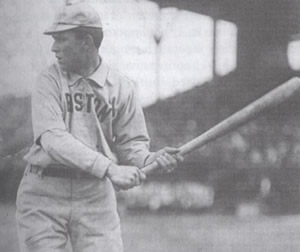
When the old Sulphur Dell ballpark, located in downtown near the Cumberland River would flood, Vanderbilt was an alternate site for baseball. The original Dudley Field was located on the present site of the Vanderbilt Law School where the Commodores played football and baseball.
 |
|
| Tris Speaker |
A heavy rain forced an exhibition game in April 1914 to be moved to the Vanderbilt campus. The hometown Nashville Vols of the Southern Association played the Boston Red Sox of the American League. The Red Sox were led by future Hall of Famer Tris Speaker.
The Nashville Tennessean reported on the game:
With Tris Speaker in the leading role, the Boston Americans hit a couple of Nashville’s supposedly classy pitchers hard in the opening game of the series, winning by a score of 8 to 2. The contest was staged on Dudley Field as a result of damp conditions of the league park, and several hundred people turned out to see the ex-world’s champs, and, incidentally, to watch the famous Mr. Speaker of $18,000 a-year fame, bruise the sphere.
The center fielder was in a most accommodating frame of mind, which was noted when he approached the plate in the first inning with Clyde Engle roosting on first base as a result of a safe hit. Tris took a healthy swing at one of Bernie Boland’s shoots, and it rose gently over the bunch of trees behind the right field seats. This homer was the longest hit ever made on Dudley Field and alone was worth the price of admission, according to the bugs.
The Red Sox beat the New York Giants in the 1912 World Series four games to three. Bill Carrigan’s Boston club would finish the 1914 season in second place (91-62) behind the Philadelphia Athletics (99-53). These are the Red Sox players that started at Vanderbilt:
Harry Hooper, RF–The Veterans Committee elected Hooper into the Baseball Hall of Fame in 1971. He played for Boston (1909-20) and the Chicago White Sox (1921-25). Hooper played in four World Series for the Red Sox. In his career, Hooper batted .281 in 2,308 games with 75 home runs and 817 runs batted in.
Clyde Engle, 1B–Engle played for the Yankees (1909-10), Red Sox (1911-14) and Cleveland (1916). A .265 lifetime hitter, Engle played most of his career as a utility player. He his best remembered for his pinch-hit fly ball that was muffed in the 10th inning of the final 1912 World Series game. Engle scored the tying run on a Speaker hit that Boston won later that inning, 3-2.
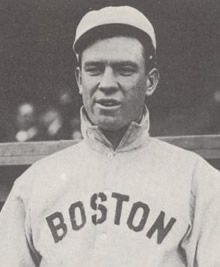
Tris Speaker, CF
–Speaker was elected into the Hall of Fame in 1937 after playing with the Red Sox (1907-15), Cleveland (1916-26), Washington (1927) and the Philadelphia A’s (1928). Speaker was also the player-manager with his stint in Cleveland. For a career, he batted .344 in 2,789 games recording 117 home runs and 1,559 runs batted in.
Duffy Lewis, LF–Lewis played for the Red Sox (1910-17), Yankees (1919-20) and Washington (1921). In 1914, Lewis became the first major leaguer to pinch-hit for Babe Ruth a Red Sox rookie pitcher. Lewis batted .284 in his career driving in 793 runs with 38 home runs. Lewis with Speaker and Hooper were considered the best outfield in baseball during that era.
Larry Gardner, 3B–Gardner played for the Red Sox (1908-17), Philadelphia Athletics (1918) and Cleveland (1919-24). He was a University of Vermont graduate when he joined the Red Sox. Gardner was a 17-year veteran who batted .289 in 1,922 games. He recorded 27 home runs while driving in 929 runs and played in four World Series.
Hal Janvrin, 2B–Janvrin was a Boston native who played for Boston (1911-17), Washington/St. Louis N (1919), Cardinals (1920) and Brooklyn (1921-22). He only batted .232 in a reserve role. Janvrin only collected six home runs in 756 career games.
Everett Scott, SS–Scott played for Boston (1914-21), Yankees (1922-25) and White Sox/Cincinnati (1926). For eight straight seasons (1916-23) Scott led the American league in fielding. Scott played in 1,307 consecutive games before Lou Gehrig passed him. He was a lifetime .249 hitter in 1,654 career games.
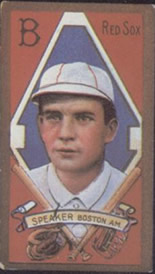
Hick Cady, C
–Cady played for Boston (1912-17) and the Phillies (1918). The part-time backstop batted .240 in 340 career games. Cady recorded one career home run in 901 plate appearances.
Adam Johnson, P–Johnson was a rookie in 1914 that played for the Red Sox/Chicago FL (1914), Chicago/Baltimore FL (1915) and the Cardinals (1918). He only played part of the 1914 season with Boston where he was 4-9 in 16 games. As a major leaguer he appeared in 72 games recording a 23-30 slate.
The Tennessean said this about Speaker playing on the Vanderbilt campus:
Speaker’s great playing while in the line-up was the distinct feature of the game and the fans who had never seen the Texan before marveled at his ability. His day’s work with the stick was a home run, and two singles one of which was a perfect bunt which he beat out with ease, while his fielding was also fine. Tris plays in closer than the usual run or center fielders because of this ability to go back after long hits with his great speed, and yesterday he demonstrated his talent on more than one occasion.
Speaker died in Lake Whitney, Texas on December 8, 1958 at age 70.
Traughber’s Tidbit: Actor Joe E. Brown (1892-1973) visited with the Vanderbilt baseball team during a trip to Nashville in 1940. Brown began his movie-acting career in 1928 and made three baseball movies considered classics. This trilogy of baseball movies include “Fireman Save My Child” (1932), “Elmer the Great” (1933) and “Alibi Ike” (1935). Brown was also a television and radio announcer for the Yankees in 1953. Brown’s son, Joe L. Brown, was a longtime general manager for the Pittsburgh Pirates. Brown’s best-known character was in the movie “Some Like It Hot” in the role of millionaire Osgood Fielding III. In the movie he fell for Daphne played by Jack Lemmon in drag.
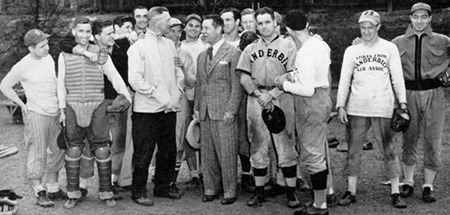
Joe E. Brown is pictured in the middle wearing a suit.
This is the last Commodore History Corner story. I hope you have enjoyed the past three years learning about the great history and traditions of Vanderbilt athletics history.
If you have any comments or suggestions you can contact Bill Traughber via e-mail WLTraughber@aol.com.