

Called to Serve
by Graham HaysAfter coming back from a debilitating injury, graduate transfer Carly Hendrickson chose Vanderbilt to extend her present on the court and build a future in special education
NASHVILLE, Tenn. — Perhaps not even Carly Hendrickson would advise anyone to follow precisely in her footsteps. Not when, for a time, each of those steps proved so painful. Not through the surgeries, first on one hip and then a few months later on the other. And not through the long days of rehab and the no less lengthy nights of doubts.
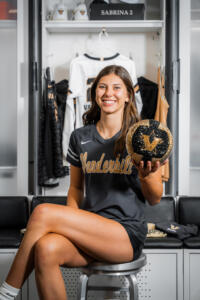 An outside and graduate transfer newly arrived in Nashville after beginning her college career at Florida and then three years and one remarkable comeback at UCLA, Hendrickson took a winding path to Vanderbilt. But it was the long road to the right place. Dedicated to a career in special education but not ready to walk away from the sport for which she relearned how to walk, Vanderbilt is the right place to take the next step.
All of which makes her the right person to help a second-year program take its next steps.
A Volleyball Journey Interrupted
Hendrickson grew up in the Cincinnati area, but her parents now live in Nashville (a grandfather, Shelton Johnson, is also a Vanderbilt alumnus). And the city played a central role in her volleyball journey even before she became a Commodore—indeed, before Vanderbilt returned to the court after a 45-year hiatus. Shortly after the 2023 season at UCLA, Hendrickson’s first with the Bruins after her freshman year at Florida, she visited Nashville for successive surgeries on her hips, first the left and three months later the right.
She had played through progressively worse pain and discomfort, competitive stubbornness keeping her going even as activities as simple as sleep and walking any distance became arduous. At the same time, unable to meet her own expectations on the court, she wondered sometimes why she bothered to persist. The surgeries were supposed to help, of course, but the long rehab process—12 months before she was cleared for a full return—came with its own mental and physical challenges.
In high school, she had been two-time state player of the year in Ohio and an AVCA first-team All-American. Just a few years later, she could only sit and watch practices or weight lifting sessions, trying to soak up some of the camaraderie before she headed to classes and spent hours on her own in physical therapy and rehab. All with no guarantee she would get back on the court, let alone be the commanding presence that once seemed certain.
She gave herself the grace of some occasional grumbling, but she kept going. Returning to the court last season, she played a key role for a team that reached the NCAA Tournament.
“I just wanted to play with joy—everybody says that, but I truly did,” Hendrickson said. “I really feel like I’m in touch with my body, and I’m just grateful for what it allows me to do because I didn’t know if I’d get back here. It’s crazy to me, looking back to when I was relearning how to walk, and then 10 months later I’m jumping around on the volleyball court.”
Time away from the sport left no doubt in her mind that she wanted to return. It also sharpened focus on whyit mattered so much to her. It wasn’t for the awards and honors. Even the wins proved to be something closer to effect than cause of her joy. Success was the byproduct of experiencing a shared purpose and bonds difficult to find and forge anywhere else.
“I think people choose a team sport because you can be having a hard day, but there are 16 girls who know exactly what you’re going through for the most part,” Hendrickson said. “Walking into the gym or the locker room, and whether it’s being in conversation with people or just listening to them interact, it’s just such a unique and cool experience.”
A Future in Special Education
Hendrickson graduated from UCLA with a sociology degree and an additional year of eligibility after sitting out the 2024 season. Healthy again, she wasn’t ready to be done with the sport after just one reclaimed season. At the same time, she also wasn’t eager to put her future on hold. She loved her time in Westwood, but the school’s graduate offerings didn’t fit her plans.
Growing up among several family members with autism, including one who is largely non-verbal, special education has been part of her life just as long as has volleyball. Early on, she thought she would likely feed her interest through volunteer work and efforts outside a primary career path. But as she progressed through college, she realized she didn’t want the thing that mattered most to her to be a hobby. She wants the hands-on day-to-day experience of teaching in a classroom, even understanding the field’s high rate of attrition and burnout. Beyond that, she’s intrigued by the idea of one-on-one settings in early childhood, working with families and preparing children to begin school. She wants to correct the misconception that anyone is beyond learning.
“We talk a lot in special education about the idea that every child has the right to have access to education,” Hendrickson said. “It is more difficult, 100 percent, but every child is deserving of that. And just because somebody might communicate differently doesn’t mean that they’re incapable of learning. They might express their emotions differently. That doesn’t mean they’re not feeling the same things we feel. And so I think a lot of times kids with special needs are really misunderstood because they just don’t know how to communicate the same way that a neuro-typical child might.”
She’ll begin Peabody College’s two-year master’s program in earnest in the fall, after completing some recommended groundwork classes this spring. The demands of the full-time program, from classroom to research to field work in local schools, aren’t a light lift.
She knew Vanderbilt volleyball head Anders Nelson from his time at Kentucky, where he nearly convinced the high school All-American to come to Lexington, and he was immediately supportive of her efforts when she reached out about trying to play this season. Peabody staff and advisors were also supportive when she outlined the unique constraints of both schedules, working with her to lighten her fall load through summer research and coursework. As someone particularly attuned to communication, she’s grateful that she could bring together the seemingly disparate worlds of athletics and an elite graduate program to collaborate.
As she put it, “Both sides are like ‘We want to do this. We want you in the program, and we want you on the team. So we’ll do what we can to make it work.’”

At Vanderbilt, Hendrickson reunites with head coach Anders Nelson, who originally recruited her out of high school in Cincinnati (Vanderbilt Athletics)
Savoring One More Season
From the unforgettable home opener on Wyatt Lawn to large crowds in Memorial Gymnasium and the reborn program’s first two SEC Tournament wins, Vanderbilt’s return offered ample promise that the season’s inevitable growing pains were sound investments.
One of two graduate transfers, along with opposite Samantha Wunsch, Hendrickson is an old volleyball soul on a roster still dominated by teammates with one or two seasons of on-court collegiate experience. Isabella Bareford, Sydney Conley, Mia Sorensen and All-SEC honoree Jackie Moore filled that role well a season ago, and it will be no less needed if the Commodores are to build on their foundation in Year 2. In that regard, Hendrickson will have reason to call on both her skill sets—those that produced 47 kills and 25 service aces for the Bruins in 2025 and those attuned to communication and group dynamics.
“In a lot of my classes, the examples I use are working on a team,” Hendrickson said. “Everybody has a different communication preference. Even if all the girls on our team are neurotypical and we know how to communicate and read social cues, that doesn’t mean we don’t have a preference for how people communicate to us. That’s kind of been my focus while settling in is learning how my teammates respond best, how do they receive feedback? And how do I respond when people give me feedback, even if it’s not in my preferred way.”
Encouraging open lines of communications can lead to some unusual conversations. If the thought of asking someone if they like how you said something to them seems awkward, imagine trying to answer it. But “uncomfortable” can sometimes be fertile soil for growth.
“It’s actually really important because we communicate a lot and quickly,” Hendrickson continued. “You don’t want to say something and somebody is thinking about it three plays later when you forgot it as soon as it came out of your mouth.”
Her road to this point was more arduous than most. She has a clearer sense of the road ahead of her than many her age. And yet, the lessons of her past and the promise of her future only strengthen her appreciation of the present. Her day-to-day campus routine will look different than most of her teammates. To stay at her best, she’ll spend more time in the training room than most, unable to jump into practice with scarcely a stretch as the younger among her teammates might—as she once blithely did. But there is something important about competing, something irreplaceable. It brought her back, and it’s worth holding onto for another year.
“We really are just people at the end of the day, and I think that gets overlooked a lot,” Hendrickson said. “We’re here to win games, but we spend so much time together—and the competition piece is literally the smallest percentage of time spent with each other and of what we do every day. We go through some really hard stuff together, and what people call trauma bonding is real. You get really close.
“I’ve known most of these girls for a little more than two months, and I know I’ll know them for the rest of my life. Athletics really does do that. And that just brings me joy.”
It also brought her to Vanderbilt. And to the great benefit of the kids she serves in the years and decades to come, it will help take her where she wants to go.
About the Anchored for Her Campaign
Through Anchored for Her, Vanderbilt’s comprehensive fundraising campaign, the university is positioning volleyball and its broader women’s athletics programs as national leaders in advancing women’s sports. Anchored for Her’s initial $50 million goal will fuel investment in sustainable success for a new era of collegiate athletics through facility enhancements, endowed scholarships, coaching and staff positions, capital support and naming opportunities, team-specific Excellence Funds, the Women’s Athletics General Fund and the Competitive Excellence Fund.