
Jan. 28, 2009
 C.M. Newton recalls career (pdf) | Commodore History Corner Archive
>>> Read More Features, Columns and Blogs on VUcommodores.com
 |
|
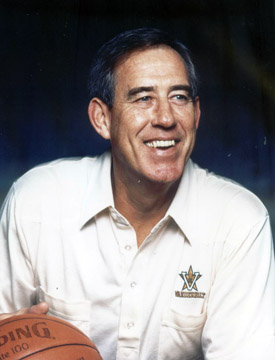
This interview with former Vanderbilt head basketball coach C.M. Newton is exclusive to Commodore History Corner and VUCommodores.com.
When Vanderbilt Athletics Director Roy Kramer was in search of a head basketball coach near the end of the 1980-81 season, a chance meeting would land a veteran and proven winner. C.M. Newton was that man. Newton was one year retired as the successful Alabama head basketball coach and in his first year working in the office of the SEC commissioner.
“I had no thought of coaching again,” Newton said recently. “When I had taken the job at the conference I was 50 years old and I thought I had enough of coaching. I had coached for 26 years and thought it was time for me to do something else. I took the job in the conference office with the idea that I would be the next Commissioner of the SEC. Dr. [Boyd] McWhorter was the commissioner and was very good about all that.
“Roy Kramer came to me at the SEC Tournament in Birmingham and said he was going to make a coaching change and wanted me to take the job. Vanderbilt was the only place that I would have left the job I had. There was something about Vanderbilt that made me say, `Yes.’ At that time in the early 1980’s there were a lot of crazy things happening in intercollegiate athletics.
“It was the one place where I felt you could truly take the student and still win. At that time there were a lot of places that were taking guys that had no business being in college. I just decided to roll the dice and do it. It was the best decision I made. In the eight years I had there were probably the most fun years for me personally.”
Charles Martin Newton was born in Rockwood, Tenn. in 1930, but moved to Ft. Lauderdale, Fla. with his family when he was only nine months old. He knew up in the Florida city and became a star athlete participating in basketball and baseball.
Newton, 79, was recruited by Coach Adolph Rupp and went to the University of Kentucky on a basketball scholarship. He played basketball and baseball in Lexington. Newton narrowed his college choices to Oklahoma A&M which is now Oklahoma State and Duke. His high school coach was from A&M and Duke was another school that gave him an opportunity to also play baseball. Newton never started for the Wildcats on the hardwood, but was a star pitcher on the baseball club.
“I remember Vanderbilt beating our 1951 Kentucky team in the Southeastern Conference Tournament when I was a junior,” said Newton. “Bob [Polk] (Vanderbilt head basketball coach) had a really good team with Gene Southwood, Jack Heldman and (Dave) Kardokus. At that time this was before Memorial Gym and they were playing most of their games at David Lipscomb College. Tulane and Vanderbilt were probably the two best teams in our conference at that time other than Kentucky.
“We had beaten Vanderbilt during the year and Rupp was upset about losing the tournament championship. At that time the regular season champion was the representative to the national tournament. And we went on to win the national championship. Rupp was very difficult to play for because his entire approach was discipline by fear. I was afraid of him the whole time I was there. Later, I got to coach against him and got to know him real well when I was at Transylvania. He was a real mentor to me.”
That 1951 SEC Tournament victory over Kentucky 61-57 is Vanderbilt’s only championship in the SEC postseason event. The Wildcats were 32-2 (SEC 14-0) during that season winning a national title over Kansas State in Minneapolis, Minn. Newton averaged 1.2 points per game as a bench player. His teammates on that historic team were Bill Spivey, Frank Ramsey, Cliff Hagan and Walt Hirsch.
Newton’s real passion and talent came on the baseball diamond. He signed a baseball contract and was in the New York Yankees organization for three years. Newton played for Mayo Smith in Norfolk, Va., and Muskegon, Mi. of the old Central League. He would be teammates with many future Yankees as Tony Kubek and Bill (Moose) Skowron.
When a gambling scandal hit the college basketball world in the late 1940’s and early 50’s a few Kentucky basketball players were implicated. The scandal caused a sudden opening for the Transylvania College (Lexington, Ky.) head basketball coaching position. Their new coach, a former Wildcat, was implemented in the scandal.
“I had signed a baseball contract and forfeited my senior year of eligibility at Kentucky and it was the year of the basketball scandal,” Newton said. “The scandal hit in October while Transylvania was already into their practices. I got a call from Coach Rupp telling me to go see Coach [Harry] Stephenson that Transylvania needed a basketball coach and he recommended me.
“So, I went over there and worked out a situation where I could coach their basketball team while receiving credit in my student teaching, which was about most of what I had left for graduation. I ended up coaching there on a part-time basis as a senior in college. The players were older than me. I coached that year and the next then went into the Air Force for a couple of years.
“I came back and played a couple years of professional baseball and that’s when I decided to take Transylvania’s job full time. I had to make a decision to stay in baseball or begin coaching full time. I chose to go full time at Transylvania since I now had a family.”
In Newton’s first year at Transylvania in 1956, his Pioneer’s were 9-8 in N.A.I.A. competition. In his 12 years at the small Kentucky college, Newton compiled a 169-137 record. His 1963 squad was 20-9 landing a berth in the National Tournament.
While at Transylvania, Newton recruited the school’s first black player effectively integrating the college’s athletics. Newton was inducted in the Transylvania’s Pioneer Hall of Fame in 1992. The 39-year old was ready to leap into the big time of college coaching.
“I was at Transylvania for 12 years and during that time I was able to do a lot of scouting and other things for Coach Rupp and staying active around the Southeastern Conference,” Newton said. “Coach [Paul “Bear”] Bryant was the head football coach and Athletics Director at Alabama. The fellow who hired me at Transylvania, Dr. Frank Rose, was the President at Alabama. So when they made the coaching change in 1968, Coach Bryant asked me if I wanted the job. I took it and came to Alabama.”
The University of Alabama was a football school and the basketball program had won two SEC crowns (1934 and 1956) while never appearing in the NCAA National Tournament prior to Newton’s arrival. Newton changed all that.
In his 12 years leading the Crimson Tide, Newton would win the SEC championship in three consecutive years (1974-76) with 15-3 records. One of those conference titles (1974) was shared with Vanderbilt. The Commodores got the nod to represent the SEC in the NCAA Tournament due to a tiebreaker in which Vanderbilt defeated Bama twice during the regular season.
“Vanderbilt had integrated the conference with Perry Wallace and we integrated the program at Alabama in 1968-69 with Wendell Hudson,” Newton said. “He was a great player, an All-American and Player-of-the-Year in our conference. That led us to more great players in Ray Odums, Charles Cleveland, T.R. Dunn, Anthony Murray, Leon Douglas and Reginald King. We had a run of really outstanding players from the state of Alabama.
“I take great pride in the fact that we won conference championships and won 20 or more games in seven years. We graduated all of our players except for maybe three guys. That was very important to me that we didn’t just use these guys as athletes and turn them out. They all got their degrees, which was very important. That stabilized our program and gave us national attention with the basketball program. The difference was then while we were winning conference championships, Coach Bryant, in the decade of the 1970’s, was winning national championships in football.
“I don’t think the Alabama people fully appreciated at that time what we had accomplished. They did later. We had one team good enough to win a national championship and that was our 1976 team. Had we gotten by Indiana (regional semifinals), which was their undefeated year, we would have won the thing.”
Alabama appeared in two NCAA Tournaments and four NIT appearances in Newton’s tenure. He was the SEC Coach-of-the-Year in 1975 and 1976. Newton’s overall record for the Tide is 211-123.
In 1980, Newton resigned to become an assistant in the Southeastern Conference office. Until Vanderbilt’s Roy Skinner retirement in 1977, he gave Newton some healthy competition.
“He was a great coach and never got the credit for his coaching and teaching ability,” Newton said about Skinner. “Many people thought of Roy as a recruiter and he was. Vanderbilt recruited a certain type player. Roy could really coach basketball. They were really solid with good assistant coaches. Next to Kentucky, Vanderbilt was what I envisioned a program ought to be. Back then there were no pro sports in Nashville and Vanderbilt was the attraction. A lot of sidewalk alumni, people who never stepped into a classroom at Vanderbilt, supported the program. You go into old Memorial Gymnasium it was a happening and Roy made it that way.”
With the dismissal of Coach Richard Schmidt who led the Commodores for two seasons with controversy, Kramer persuaded Newton to leave the administration side of basketball for the Vanderbilt campus.
Vanderbilt was coming off seasons of 13-13 and 15-14 when Newton took over. His first piece of business was recruiting.
 |
|
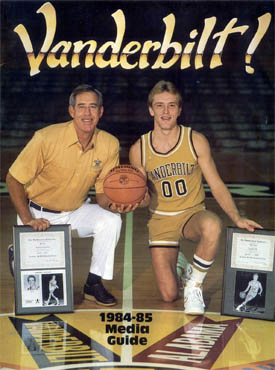
| C.M. Newton (left) with Phil Cox |
“Phil Cox was the first guy we signed and we were very fortunate to get him,” said Newton. “I didn’t have any recruiting mentality being in the conference office that one year and didn’t pay any attention to recruiting. A good friend of mine in Kentucky told me about Phil and said he was unsigned. We signed him right away. Then from there we recruited players like [Barry] Goheen, [Barry] Booker and guys that turned out to be very good players for us.”
Cox would become Vanderbilt’s all-time leading scorer with 1, 724 points surpassing the great Clyde Lee (1,691). Cox scoring mark has been eclipsed by Matt Freije (1, 891 and Shan Foster (2,011).
“Everybody talks about Phil being too small, but when I saw him I thought this guy could really play,” said Newton. “The reason he hadn’t talked to any other schools was because he wanted to go to Kentucky. Phil was waiting to see if they were going to give him a scholarship. We just jumped in there and convinced him to come to Vanderbilt.
“We had Jeff Turner, Al McKinney, Jimmy Lentz, Jeff Gary and Ted Young. We had a lot of good players that Coach Schmidt had. They were young, but we had some good success with them.”
The 1985-86 recruiting class would make Vanderbilt Commodore history before they graduated. Players like Goheen, Booker, Frank Kornet and Will Perdue were standouts.
“They were very skilled and could shoot the ball,” said Newton. “Little Derrick Wilcox, Scott Draud, Steve Grant and Steve Reese were guys that could play. They knew how to play and shoot it. We had some size when you put Kornet and Perdue in the game together, which we did. We had a good inside game.”
Perdue would become the SEC Player-of-the Year as a senior and a First Team All-SEC selection as a junior and senior. He led Vanderbilt in scoring and rebounding both seasons. Purdue’s dominance occurred after accepting a red shirt after his sophomore season.
Newton was asked about the sudden change in Purdue’s playing ability from one year to the next.
“Will grew up,” Newton said. “It was an academic decision not an athletic decision to give him a red shirt after his sophomore year. That year helped him more than anything. In his junior and senior year, Will just dominated the conference. He was not only the SEC Player-of-the-Year in basketball, but also the Athlete-of-the-Year in the SEC his senior year. That doesn’t happen very often with basketball players. Of course, he had a tremendous career in the NBA. I’m very proud of Will and his continued support, concern and love for Vanderbilt. He has maintained that.”
The 1986-87 season would find news rules for college basketball. The 3-point shot and shot clock was implemented. Newton had the foresight to recruit players that would benefit from the changes. Through the Florida game this past Sunday, only Vanderbilt, UNLV and Princeton can claim to have scored at least one 3-pointer in every game since the rule was set in place. The streak for the Commodores is 717 games.
“I was chairman of the rules committee so I certainly did see that the 3-point shot would change the college game,” Newton said. “We experimented with it in the Sun Belt Conference and other conferences with the 3-point shot. While I was chairman of the rules committee that year we put in the shot clock at 45 seconds, the 3-point line and the coaches box. These were three very major changes.
“I also was one of the Olympic coaches in 1984 and coached internationally since the mid 1970’s when I was at Alabama and the rest of the world was playing some with the 3-point line. I knew what effect it would have on the game. Basically, we told our players that we were going to construct our offense around the 3-point shot and eliminate our mid-range jump shot. We will shoot the three or take the basketball inside. We eliminated that 15-16-foot shot. We had very good shooters. We were up there in leading the nation in attempts and 3-pointers. It became a very big part of what we were about. They had that Bomb Squad stuff that was kind of fun.”
Under Newton’s guidance the rebuilt Commodores were gaining national attention with its Bomb Squad and upset victories. During the 1986-87 season Bobby Knight brought his No. 2 ranked Hoosiers into Memorial Gymnasium and left with a 79-75 loss. Indiana would finish that season as national champions.
The next year Dean Smith and his confident No. 1 ranked North Carolina team rolled into Nashville with the same outcome. The Commodores squeaked past the Tar Heels 78-76 on a December evening.
“I was talking to Jeff Lebo (former Tar Heel player and current Auburn head coach) not too long ago about that game. The thing he remembered was we fouled him and wouldn’t let him shoot the 3-point shot. If you fouled a 3-point shooter he got two shots. That was the rule at that time. We weren’t going let him shoot the three so we just fouled him. He made one of his two foul shots. It was a risky thing. I’d do it again than let him shoot the three.”
The 1987-88 would be memorable for Vanderbilt fans. The Commodores seemed to hit a peak with blowout wins over Kentucky (83-66), Florida (92-65), Mississippi State (82-66), Tennessee (90-62) and Mississippi (93-68).
“We played about as good as a team could play,” said Newton. “We were very solid defensively and we had good board work. We handled the basketball and shot it well. We did all the things you had to do to win.”
That exciting season would see the Commodores conclude the season at 20-11 and an appearance in the Sweet Sixteen of the NCAA Tournament. They opened with a win over Utah State that set up a match with No. 8 Pittsburgh. Goheen hit a 3-pointer to bring the Commodores within three points with only seconds remaining. He hit another 3-pointer just seconds later to send the game into overtime where Vanderbilt won 80-74.
“When Will Perdue fouled out of that game, I told them we were going to win,” Newton said. “And Will did too. When Goheen got the shot and sent it into overtime, we felt confident. Pittsburgh was the No. 1 ranked team in our region, the top seed. It was one of those few times where an eight or nine seed beat the No.1 seed.”
Vanderbilt would lose its next game to eventual national champion Kansas with All-American Danny Manning leading the way. The Commodores lost to the Jay Hawks, 77-64 to end the season.
“We were hoping that Manning didn’t have a great night,” said Newton. “Manning was a lot like Pete Maravich to me. He is going to get his points and when they go to him he creates so well. You had your choice. What we did was to let him get his points. We took the attitude that we would guard him head up and guard the heck out of the rest of them. And hope that he didn’t go off. But he had such a great night on us that it didn’t work.”
Goheen has become a Vanderbilt legend with his last second heroic shots to win games. Newton remembers of those Herculean nights at Memorial Gym during the 1988-89 season against Georgia.
“When we came out of a timeout two points down, Kornet blocked a shot so we came back down the court with the ball,” Newton reminisced. “We just talked about how we didn’t need a three, we just needed a two. Goheen gets the ball on the fast break with the clock winding down. He dribbles it to the corner and shoots the three and makes it. I’m thinking he doesn’t know the score. I went to him and said, `Barry, what in the world were you doing? As intelligent as you are, weren’t you listening during the timeout?’ He said, `Coach, I knew the score. I just didn’t think you could handle overtime.'”
In that same year, Vanderbilt was involved with one of the most controversial calls by an official that Commodore fans remember today. Vanderbilt entered the January game at Memorial Gymnasium with an SEC record of 4-2. The Florida Gators were 4-3.
The Gators center was Dwayne Schintzius who was involved in some type of skirmish the previous year that resulted in a fight with tennis rackets. In previous games, Gators’ opponent’s fans would toss tennis balls at Schintzius. This resulted in a warning to fans that this behavior would result in a technical foul on the home team.
With six seconds left in the game and Vanderbilt ahead 71-70, Kornet pulled down a rebound on a Florida missed field goal attempt and was fouled. Kornet hit the first of a two-shot opportunity, but missed the second attempt. Florida secured the rebound and fired the ball down court and out of bounds. The clock revealed one second and the Commodores would have had possession and an apparent 72-70 win. But as the ball sailed out of bounds, a tennis ball came flying onto the court.
Official John Clougherty charged the scorer’s table to call a technical against Vanderbilt. Schintzius stepped to the free throw line and sank both pressurized free throws. The Commodores would lose in overtime, 81-78.
“It kept us from winning the conference,” Newton said about the infamous tennis ball game. “My gripe at that point was it puts another loss on Florida and we would have won the league. To have that happen, and not have any other incidents of things being thrown on the court early without a warning or nothing was to me inexcusable. It cost us the SEC championship. There was one second on the clock and we’ve got the ball getting ready to throw it in.
“There was no way we were going to lose. We were going to win the game and then all we’ve got to do is win no matter what Florida does and we’re the champions. It was crazy to call that technical. It could have been somebody from Florida that threw the tennis ball out there. If you had 30 tennis balls thrown on the court or barrage at Florida then that would have been different. But to have one tennis ball thrown out there and for the official John Clougherty to act that way was inexcusable.
“I think he just overreacted. Kornet fouled out and now we’ve got to go through overtime with Schintzius still in the game and our center fouled out. At the time I told Clougherty, “John, I’ve always been a forgiving person, but I don’t think I will ever forgive you for that.'”
Until his retirement a few years ago, Clougherty had been booed at every Memorial Gymnasium game since that incident when his name was announced before a game. He is now the ACC supervisor of basketball officials.
Just before that Florida game Newton announced that he would be resigning at the end of the season to take the athletics director’s position at Kentucky. Vanderbilt finished that season at 19-14 and a first round loss to Notre Dame in the NCAA Tournament. The Commodores finished in second place in the SEC one game behind champion Florida.
“I had no thought of leaving Vanderbilt,” said Newton. “Kentucky had contacted me in early December and had offered me the athletics director’s job. I turned it down. I told them I wanted to coach Vanderbilt and that I was going to retire there. I had an opportunity to meet with their president right after the first of the year on an accidental basis. He convinced me that I was not only wanted, but I was needed. The “need” part really got to me.
“I decided it was my school that was in real trouble. They had all kinds of NCAA problems. It was my school that I had gone to and played for and being wanted wasn’t enough, but being needed tipped it. I talked to Roy [Kramer] about it and we decided that rather than have all the speculation out there, we would go on and announce it. I told our players don’t listen to this business about a lame duck coach. I may be a duck and I may be lame, but I’m not a lame duck.”
Newton’s eight-year record at Vanderbilt was 129-115. He was also SEC Coach-of-the-Year in 1988 and 1989. Newton would hire Tubby Smith in 1997 as Kentucky’s first black head basketball coach. He also hired Bernadette Mattox the university’s first black women’s head basketball coach in 1995.
Newton was the Wildcats athletics’ director from 1989-99. His overall record as a coach is 509-374. Newton has received many honors and awards throughout his career. In 2000, Kentucky officially named its football playing field at Commonwealth Stadium in honor of Newton. The University of Alabama named a recruiting suite for Newton in 2006. Newton became a member of the prestigious Naismith Memorial Basketball Hall of Fame in 2000 as a contributor to the sport.
Today, Newton lives in Tuscaloosa and is an assistant to SEC Commissioner Mike Slive. So, what does Newton think about Memorial Gymnasium?
“It was and still is very special,” Newton said. “It is a wonderful facility. I love the crowd being so involved. The real beauty to me at Vanderbilt is it’s a university that puts a real emphasis on athletics, but understands the true nature of the university and that’s an education.
“They have never sacrificed the educational pursuits for athletics. They are one of the few places in this time of big-time athletics where the decisions made are not bottom line dollar decisions nor are they on the athletic side. They are academic decisions and I have always admired Vanderbilt for that.
Traughber’s Tidbit: There will be a reunion on February 7 honoring the 1988-89 men’s basketball team during halftime of the Ole Miss game. There will be a pregame brunch hosted by the Nashville Vanderbilt Alumni Chapter and the team will be honored there also.
If you have any comments or suggestions you can contact Bill Traughber via e-mail WLTraughber@aol.com.