
Jan. 14, 2009
 Bob Dudley Smith recalls career (pdf) | Commodore History Corner Archive
>>> Read More Features, Columns and Blogs on VUcommodores.com
 |
|
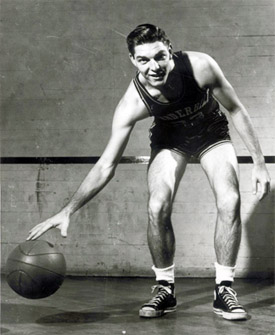
If you ever have the chance to visit with former Vanderbilt basketball player Bob Dudley Smith you will leap into Commodore history. Smith was the second high school basketball player to receive a Vanderbilt scholarship from Coach Bob Polk.
“I was born two blocks from the football stadium on Capers Ave,” Smith said recently.
“When I was about seven years old my mother let me have a quarter and I’d sit in the North end zone for the football games back as far as 1938. I had five brothers and three sisters so we had a big family.
“Billy Joe Adcock was the first basketball scholarship player at Vanderbilt. He graduated in 1946 from West End High School. I played behind him at West. During that time Vanderbilt played its basketball games all over the city at the Classification Center, the Hippodrome and Father Ryan.”
At West, Smith made three consecutive trips to the TSSAA state basketball finals capturing two titles (1946 and 1948) and finishing as a runner-up (1947). West was in the district of four Nashville junior high schools, Talbot, Tarboux, Waverly-Belmont and West End, which contributed to the high school’s sport’s talents.
As a senior Smith was named as the Nashville Banner’s 1948 Interscholastic League’s Most Valuable Player. He was also named to the Tennessee State Basketball Tournament All-State Team in 1947-48 while becoming Tennessee’s Most Outstanding Men’s Player in 1947-48.
“I could have played for any college in the country like Kentucky, Purdue and Tennessee,” said Smith who is 78 years old. “My performance in the finals of the state tournament put me on the map. I was living more than two blocks from Vanderbilt with Billy Joe as my friend. We grew up together playing on his basketball goal that his daddy put up over the garage. He only lived 50 yards from my house and the goal had lights so we could play all night.
“In my junior year at West, Coach Polk had promised me a scholarship when I graduated. Billy Joe told him you better get Bob Dudley, he’ll be wanted by everybody. We were driving home on a bus from Knoxville that broke down in Cookeville after we won the state tournament. Coach Polk was over at my house waiting on me for four hours to sign the scholarship papers.
“We had little communications back then so he didn’t know what had happened to us. Mother said he got tired of waiting and asked that when I got home to call him. He had the papers for me because he knew I was going to be heavily recruited. During the tournament in Knoxville, I was at that time the leading scorer in the TSSAA for a four-game tournament.”
Smith also played baseball and had to choose between a bonus contract with the Boston Red Sox or a Vanderbilt basketball scholarship. He said he chose Vanderbilt because he knew he would get a good education and baseball could still be an option after graduation.
During the summers, Smith did play semi-pro baseball and spent time in training camps of Pittsburgh, Milwaukee Braves and Detroit. His basketball eligibility was never in doubt, as he never received any benefits from the professional baseball clubs. Smith also became a Naval Reservist since this was the time during the Korean War. By joining the reserves it practically assured himself from being drafted during his studies at Vanderbilt.
“When Coach Polk was recruiting us he said that we would be playing in a new gymnasium by the time we were sophomores,” Smith said. “He brought out these architectural drawings of this gym because he knew that he didn’t have anything there. They just had this little practice gym. It was an annex on the Old Gym that was built in 1880. The annex was added in the 1940’s.
“There was just enough room for two rows of seats on the outside of the lines of the gym. They also used the Old Gym as a stage for performances and plays. They had a track that ran around the gym as a balcony and we would run that track to get in shape. During my freshman year the varsity played at East High School for the home games.
“When we became sophomores we began playing our home games for the next three years at David Lipscomb College that built a new gym (McQuiddy). That was a real disadvantage not playing in a home gym where you practiced everyday. We had to play on a foreign court. It is such a difference when you practice on your court day in and day out and then play a game on a Saturday and Monday at a different location.”
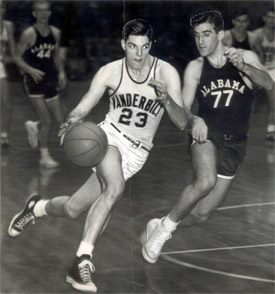
In this era of collegiate sports, freshmen were ineligible for the varsity. Smith said his freshmen class was so good that they never lost to the varsity during practice scrimmages. When Smith was a sophomore, he was a substitute behind Adcock. Other team members were Dave Kardokus, Jack Heldman, George Kelly and Hank Duvier.
 |
|
Vanderbilt was 17-8 (11-3 SEC) in Smith’s first season as a Commodore. In just his second college game, Smith played in one of Vanderbilt’s first historic wins. Vanderbilt defeated New York University 65-59 in overtime.
“It was a phenomenal experience to have the chance to fly to New York City while representing Vanderbilt University,” Smith said. “I always dreamed of playing in Madison Square Garden. It was the most famous venue for sports at the time and still is. Winning that game gave Vanderbilt immediate national exposure.
“We played just a real great game and it went down to the wire. Jack Heldman hit a shot with almost no time on the clock to tie it. Then we won it in overtime. I played in the game, but I didn’t score. Naturally it was a disappointment that I was living my dream and didn’t play very much. But the beauty of it all was putting Vanderbilt on the map. We were in the Top 20 in the nation in my sophomore and junior years. And in my senior year we were highly ranked in the preseason.”
Kentucky was the top team in the SEC and was usually ranked in the Top Five nationally each year. Coach Adolph Rupp’s teams were always bigger and stronger than its opponents. Smith said Vanderbilt should have beaten the Wildcats the first time he played against them in McQuiddy Gym.
“At David Lipscomb we were leading by three points with about a minute and 17 seconds to go,” said Smith. “We were freezing the ball with Duvier dribbling the ball around the outside and they couldn’t catch him. Finally this guy named Walt Hirsch became very impatient and he just pushed Duvier down and 4, 000 people in the gym knew it was a foul.
“The officials froze and Hirsch picked the ball up and ran down the court and made a crip shot. People could not believe that he deliberately pushed Hank down and the officials couldn’t get the foul called. They choked. I turned around to the official across from our bench and yelled, `Aren’t you going to call a foul?’ He turned his head immediately and didn’t call a foul. They came down the court with another controversial call. Rupp came off the bench and ran diagonally across the court to the free throw line to protest the call. That should have been a technical foul right there. It was not called. They ended up winning the game by four points.”
As a junior, Smith again became part of Vanderbilt basketball history with the school’s first and only SEC Tournament Championship ever. The Commodores were 19-8 (10-4 SEC). Smith was now a solid starter and a major contributor on the team. He was averaging nearly 18 points a game.
After an upset loss to David Lipscomb, Smith said there was some dissention on the team. Team captain Kelly pulled the team together and the Commodores improved their play and were facing the year-end SEC Tournament.
“We kept improving that year as a team,” said Smith. “We played the tournament in the Louisville Armory. We beat Tennessee and then Georgia to gain a little momentum. On Saturday morning we had to play LSU a team that was fast breaking and would run your tongue out. I got lucky and got into a zone and made something like 18 of 22 points and we won by 10 points. Then we had to play Kentucky that night in the finals. That was the first time that had happened playing two games in one day. (Kentucky also played earlier on Saturday defeating Georgia Tech to make the finals)
“We were only down by four points at halftime. While we were in the locker room, Kelly was standing beside me when we heard over the loudspeaker. `The Kentucky Wildcats will celebrate at the Lexington Hotel immediately following the game.” George turned to me and said, `Bob, they’ve already counted us out.’
“We were down by 10 points in the second half. I brought the ball down the court and fed (Gene) Southwood at the forward position. Southwood made a long shot. I just had the feeling that he was going to be in the zone. I brought the ball down five times and he made the shots to bring us even. Kelly made two free throws to put us ahead by two points. Then with about a minute to go I made a basket to put us ahead by four points. They didn’t score and we froze the ball to win 61-57.”
This was only the Wildcats second loss of the season. At this time the SEC regular season champion was the league’s representative to the NCAA National Tournament. Kentucky concluded the season 32-2 and became national champions with a victory over Kamas State in the title game.
“The SEC was one of the few conferences to have a tournament at that time,” said Smith. “We were invited to the NIT, but the Vanderbilt Board of Trust didn’t want us to play because a couple of schools in the NIT Tournament had a gambling scandal where players were expelled. They felt like we had a successful year so let’s just end it on top. At that time the NIT was not as prestigious as in latter years.”
Smith was selected to the All-Tournament Team as the third highest scorer in the event. He was also named to the Second Team All-SEC Team by the league coaches. The Commodores would go 18-9 (9-5 SEC) during Smith’s senior season.
One of Smith’s successes on the basketball court was his ability to shoot free throws. He led Vanderbilt in free throw percentage in each of his three varsity seasons. Smith once had 23 consecutive free throws during the 1950-51 season, a record at the time. He said that during one practice session he made 97 consecutive free throws.
Following his graduation from Vanderbilt in June 1952, Smith was activated by the U.S. Naval Reserves and served during the Korean War until March 1954. He married and joined the business world in 1956 after playing baseball in the Tigers organization. In May 1961, Smith became Executive Vice-President of the Tennessee Association of Real Estate Boards. In June 1962, Smith joined the Tennessee League of Savings Institutions Associations as Executive Vice-President and served in this capacity until 1985 when he was named president. He retired in 1993 after serving 31 years in the organization.
Smith has been a season ticket holder of Vanderbilt basketball since 1954.
“I just can’t go to a game today without analyzing the assets and liabilities of the teams and players,” said Smith. I watch the offensive setups and the defenses. I have fun watching the strategy from both coaches.
“I will go to my grave enjoying my experiences and the experiences of my teammates. I will cherish the opportunity of going to Vanderbilt basketball games until the day I die. Vanderbilt has meant so much to me.”
If you have any comments or suggestions you can contact Bill Traughber via e-mail WLTraughber@aol.com.