
April 28, 2016
As told to Ryan Schulz | Subscribe to Commodore Nation
Their eyes and quick fingers help shape the way people see Vanderbilt athletics. Their images fill this magazine, Vanderbilt’s webpages, team posters and social media platforms.
In their time at Vanderbilt, Joe Howell and John Russell have captured thousands of images, while being a part of some of the most historic sporting events in Vanderbilt’s time. As part of the Vanderbilt University photography team, Howell and Russell have spent nearly a decade on the sidelines capturing Vanderbilt’s athletic images.
Each image tells its own story, and can conjure up different memories for those who view it. To get a better understanding behind the creativity, skill and even a little luck, yes luck, of an image, I went on a quest to talk through a few recent images that stood out to the photographers. As you will see, the selected images by the photographers offer a variety of looks, settings and backstories.
BEHIND THE GLASS | Joe Howell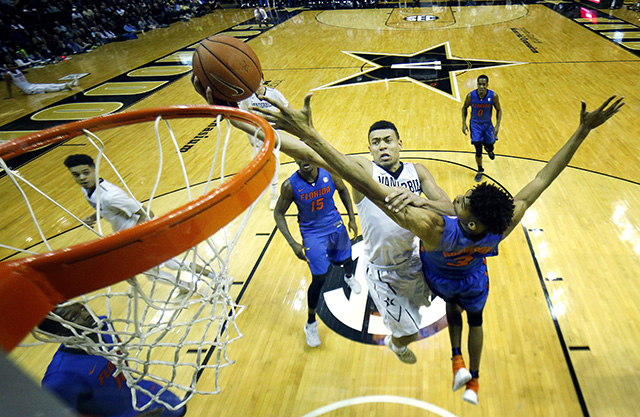
Safety first:
One fun thing we get to do is set up remote cameras at basketball. Our number one concern when doing that is player safety. When we shoot an event, we don’t want to be part of the event in that way. We use these things called Magic Arms. It is a support system that holds the camera in place. Then the second Magic Arm holds the Magic Arm in place to provide more stability and support. You don’t want the camera bouncing around, your images won’t be good, but really you don’t want it falling.
The setup:
I arrive three hours before the game begins. You want to focus at eight feet because that is where players’ heads are when they are jumping. What we use are the mops for when players fall and I’ll just get somebody to hold it up and then I just focus about where their head will be and then you preset your focus based on that.
Triggering the camera:
The remote camera is the exact same as I am holding in my hand. The one thing that makes it different and enables me to fire it is we have something called pocket wizards. We have a transmitter and a receiver. You plug the receiver into the camera and then what I can do with the transmitter is press a button and it will fire the camera. On this shot, I did not use strobes. The reason I decided to do that is to have a higher success rate. When you do it with strobes, you get one shot every two seconds because the lights have to recycle.
LIFT OFF | Joe Howell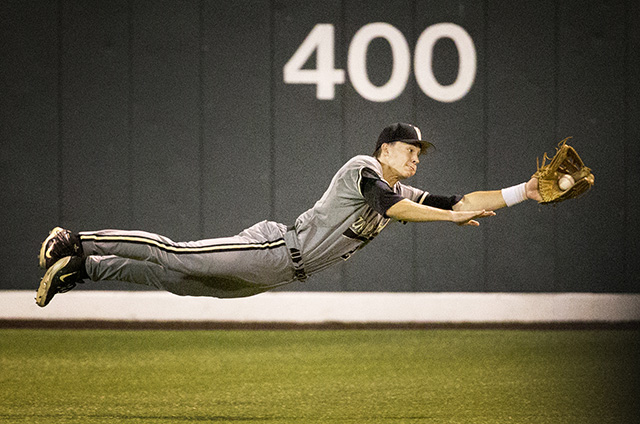
Full extension:
Any sporting event that you shoot, you want peak action. You want the play and you want it at its pinnacle. This was one of the big plays of the game and it really is at the most dramatic progression of the play. He is fully extended, so it is peak action at its best.
Shot that almost never was:
I am looking through the viewfinder with one eye watching Bryan Reynolds run and I can see out of the corner of my other eye, the umpire moving into my field of view, so I waited as long as I could and shot. I got one frame of Reynolds making the catch and then three frames of the umpire’s back.
Luck on your side:
If you look at the picture, you can see where it is so dark on the bottom and that is where he is starting to come into the frame. There is no shape to it because of the focal length. I am focusing so far past him that there is no form yet. Getting that catch, the photo gods have to be smiling on you. You can be in the right position and totally prepared and still miss a shot because of other players or an umpire.
WATER WORLD | Joe Howell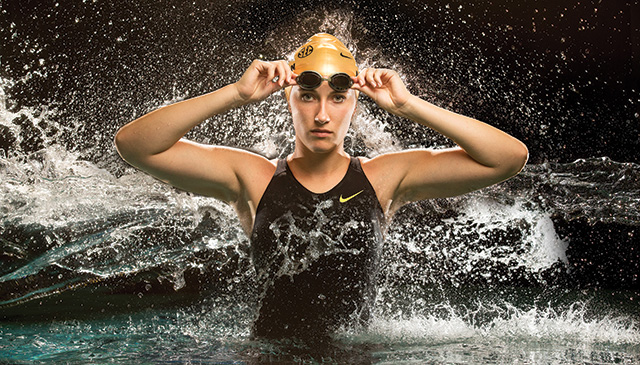
The idea:
Traditionally we have done a team shot and we have lit it up so it looks nice. I just made a suggestion that we could do something more dramatic. I had this idea about water crashing in and just making it a very dynamic shot. The swimmer is Hannah Martin and she is the only senior so it made it easy to pick who we were going to use.
The execution:
I hung a black backdrop behind her in the pool kid’s pool. I had a four-light setup and had Catherine Hilley with communications staff and other members of the swim team just throw water at her. I shot three images and then composited them together for one shot and the final product.
Gaining trust:
It is one of my favorite shots here. The way that this came about was truly getting the trust of the coach and getting the trust of the swimmer to allow me to be creative and do this kind of shot.
GATORADE BATH | Joe Howell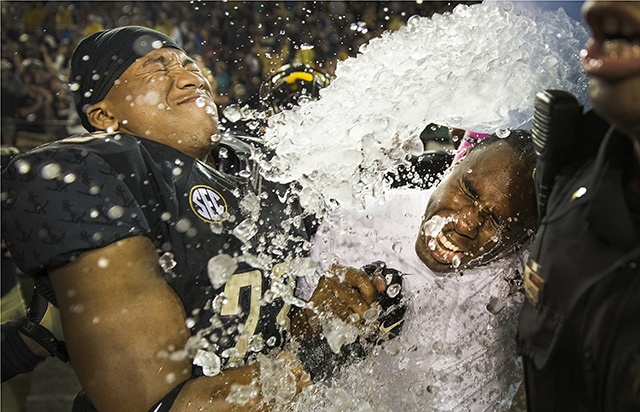
Being part of the team:
This is the nice thing about being the team photographer; you are part of the team. I am not friends with the coaches or players, but I am an acquaintance. I am somebody they know that works with the team or university. Players help me by allowing me access to their worlds so I can make images and they will let me into places that other photographers can’t get in to.
Doing your research:
I know this is going to be Coach Mason’s first SEC win if he gets it. It is important to Coach Mason and the football team if he gets it, so I am going to focus on him. I get into position. I am near him, but I am not interfering. That is the tightrope that you walk and the balance you must have.
Reacting quickly:
Next thing I know, I can see the water coming. At that point, I literally step in front of coach. It is a bit brazen. You are making the assumption that it is OK but you want to make that shot.
Capturing the emotions:
To me, I love the action and you have to have it, but the images that tell the story are the emotional images. It is players celebrating with coaches or players celebrating with each other. We are here to support the university and showcase our players and we tend to lean on the side of showing them in a good light. Those are the most powerful images. You have the action and the reaction images. Those are the ones that tell the story.
THANK YOU NOTES | Joe Howell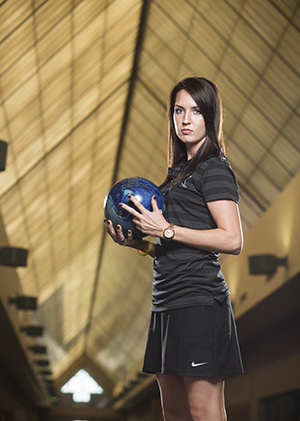
Feeling of appreciation:
I think the job that we do in the university and specifically in athletics is appreciated and it is appreciated by a lot of people. You do a shoot, you provide that service and you move on to the next shoot. I think that we all kind of deal with the task at hand and move forward. I got a nice surprise this year, a real treat when every member of the bowling team wrote me a thank you card and I still have them sitting on my desk. It made me feel good, it made me feel appreciated and that my photography is advancing our cause or our message at Vanderbilt.
Staying inspired:
It is really a great gesture and very much appreciated. It is a way to remind myself to stay inspired and do good work and that it is doing something positive for somebody.
IN THE NICK OF TIME | John Russell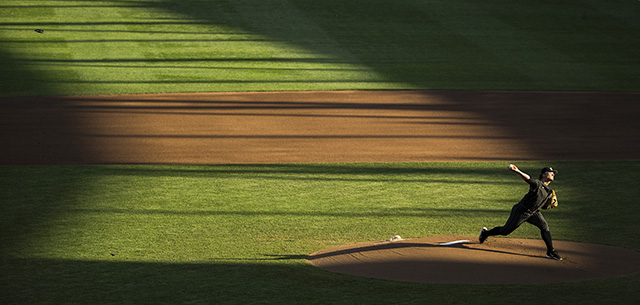
Be quick, but don’t hurry:
The sun was moving quickly through the stadium and this was right at game time. It lasts 2-3 minutes before the shadow crosses over where Carson was standing. Once the shadow crosses over his body it kills the shot. You’ve got to have that light in order to separate him from the background, especially since he’s wearing black. But here he is at the top of his delivery – it’s a shot I really like.
Location, location, location:
I was up in the stands on the third-base side, at the top of the concourse. There are fans standing all around you. You are trying to get the pitch delivery because this is another timing thing, his arm is moving and he’s throwing over 90 MPH. You can’t see this with your eye. You have to rely on the motor drive of your camera. You can get to a position and do everything you can do and still not get it because of the timing.
Images to last a lifetime:
This park in Omaha has a major league feel to it and its just great being there in that atmosphere with the fans. You definitely feel like this is something special and you try to capture that. When you go on trips like that you try to document that. Showing the environment they are in will preserve memories for years to come.
THE ACCIDENT | John Russell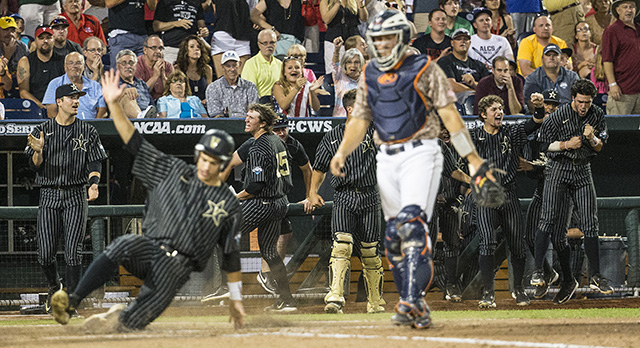
Sometimes mistakes can make your best images:I was focused on Bryan Reynolds coming in for the score but the focus sensor left Bryan about the time he was coming to the plate and hit the background to capture the reaction. If I had focused on what I intended to focus on, it wouldn’t have been much of a shot other than documenting he crossed the plate.
Thought I missed it:
I was reviewing the photos and thought I missed it, but upon closer look I notice it’s something much better than what I intended.
Capturing the emotion:Looking at this image, I make a mental note and think maybe I should be looking for that. I look for human emotion in every picture I take at a sporting event, jubilation and dejection and try to give the viewer the idea of what it felt to be there at that moment for that player.
EYES ON THE BALL | John Russell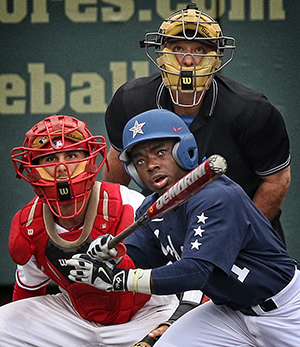
How it was taken:
I was by the batter’s eye where the crosswalk connects the two seating areas. I won’t stay in the outfield the whole game but I go out there for a couple of innings of our guys batting and try to shoot each of our guys batting. This wasn’t what I was after but it was a good outcome. Usually I’m trying to get to get shots of making connection which is hard to do to get the timing is right.
Conditions need to be just right:
It was a nice overcast day. A lot of times this shot doesn’t work with that kind of compression on the lens if the sun is out. With artificial turf, you get what we call `heat shimmer.’ That kills a shot. The camera won’t focus — like a mirage on the desert. If the sun is out at all you wouldn’t be able to focus on them. It kills that position.
About the angle:
It’s a great angle. Whenever the conditions are right, I like to be out there. Even for plays at second, it’s extremely tight on second base. You can shoot almost every position at this spot other than pitching. Good for reactions at home plate, plays at first…and the outfield.
COMING INTO YOUR KITCHEN | John Russell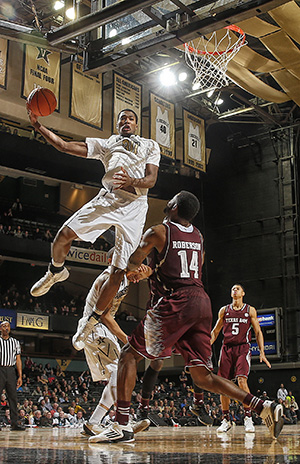
How it was taken:
This was taken with a remote inside the goal post. It’s a wide angle down low, just above floor level, a good perspective for basketball. I set the camera on a platform that puts it six inches off the ground and set it to trigger the same time as my handheld camera.
The look:
The angle makes players look larger than life, and they are already pretty big. It’s a unique look simply because we normally are not allowed in that area to shoot. We can put a camera in there remotely but it can become a hazard as well even though it’s several feet off the baseline, if nobody there to grab it and get it out of the way.
Patience is a virtue:
I used the strobes to light up the shot, and with the strobes, you get one shot every two seconds, which seems like eternity so you have to time your shot. When shooting with available light, you can shoot 10 frames a second. With a strobe, you have to be patient. More often than not, you will shoot too early rather than too late.
THE SHADOW | John Russell
How it was taken:
Usually I’m on the court shooting but at this time I went up an elevated position to where the fans are sitting. I don’t know if I’d have noticed the shadow if I had been on the court with her. I’m elevated here — camera level about 10 feet above her above the ground. It gave me the perspective for the shadow.
The beauty of light:
Tennis is an action-based sport but sometimes the lighting can be crazy and contrasting which it is here and you look for different things. I just noticed the shadow on her during the match, watched it a couple of times and that would make a nice picture when she was serving.
Timing is everything:
Even with 10 frames per second it’s not easy catching the ball on the racquet because that racquet is whipping and they are hitting these balls 90 miles per hour. It’s like trying to catch a ball on a bat – not easy!