
Feb. 10, 2016

Commodore History Corner Archive
Once when Vanderbilt head basketball coach Bob Polk (1948-58, 1960-61) was on a recruiting trip in Indiana, he was given a birthday present by a future two-time First Team All-SEC and top rebounder in Commodore history.
“Coach Polk came to our home on his birthday and my mother baked him a cake,” said Bill Depp, an Edinburgh, Ind., native. “We had cake and I signed that night. I guess that was his birthday present form me. Polk was from Tell City, Ind., and was recruiting in Indiana and Kentucky, which made up most of our team.
“I signed with Vanderbilt without seeing Nashville or the campus. I wanted a smaller campus. I came from a small town with a small school and a small class. I just felt it was a better fit. My parents were pleased because of the academics. I was born in Louisville and grew up a Kentucky fan, but moved to Indiana when I was in the seventh grade. I still had strong feelings about Kentucky.”
Depp (1959-61) was a two-time MVP, All-County, All-Sectional player that produced a record-breaking 65-point, 31 rebound effort against Charlottesville his season at Edinburgh High School. He also set a Johnson County career scoring average record (24.7).
Also trying to secure the 6-foot-7, 200-pound center for his signature on scholarship papers were Louisville, Memphis State, Georgia Tech, Ole Miss and numerous northern schools. Kentucky, coached by Adolph Rupp, also wanted Depp. Said Depp, “I met Rupp in his office, but he really did not put on a big spill about ‘we really want you.’ He talked about a lot of things like cows and the cattle that he owned.”
In this era of college sports, freshmen were ineligible for varsity competition. The Vanderbilt freshman team played 18 games with only one SEC school, which was Kentucky. Games were played with teams as Middle Tennessee (B-Team), Paducah Jr. College, Lindsey-Wilson, Campbellsville and Stewart’s Air Force Base. Assistant coach Roy Skinner was the freshman head coach.
“Coach Skinner was in his first year at Vanderbilt when we were freshmen,” said Depp. “We drove to most of our games in cars. Skinner owned a station wagon and that’s how we got to most of our games. I remember our last game, an away game; we stopped to get something to eat.
“We were in the car with Coach Skinner. Unbeknownst to him, we all got a cigar and enjoyed them on the way home and he didn’t say a word. He just let it go. He didn’t have a lot of rules, but we knew to watch what we were doing. He would let us have some leeway.”
Just before the start of Depp’s first varsity season, Polk was on a recruiting trip where he suffered a heart attack. He was in a Paducah, Ky. hospital for three months recovering. Skinner was named as interim head coach.
“There was a concern, but all we could do was buckle down and say, ‘Hey we are going to get through this thing,’ said Depp. “Coach Skinner was our freshman coach so we were familiar with him. We had some experienced players on the team like Jim Henry who was a heck of a guard. We were comfortable with the people there. We all knew each other and as freshmen had practiced against the varsity. We were all working together at the same time.”
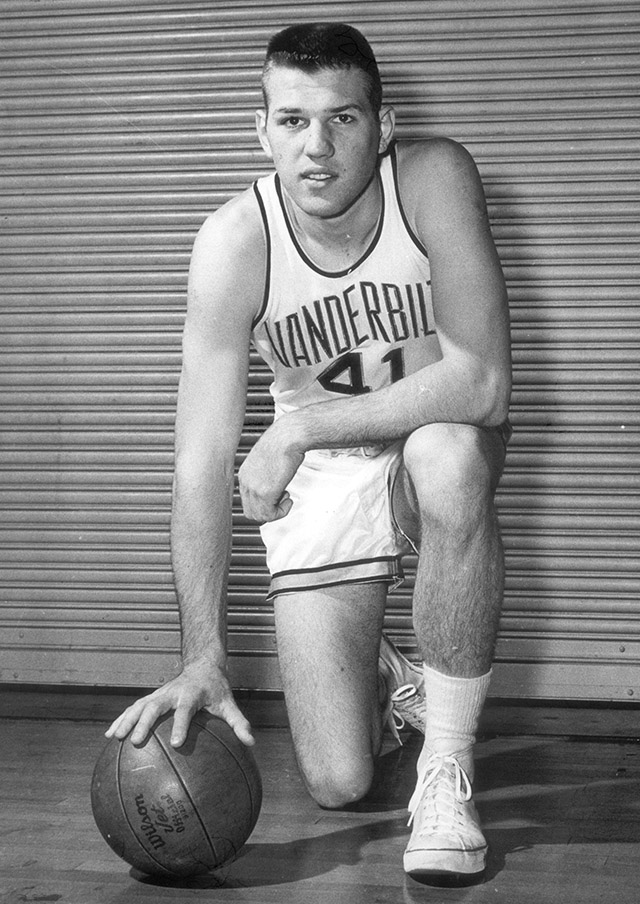
Depp’s varsity career was delayed with a broken right hand occurring just before the season (1958-59). He joined the starting lineup in the seventh game. As interim coach, Skinner, at age 28, gained attention with his coaching abilities with a victory over No. 1 ranked and defending national champion Kentucky in Memorial Gym.
“We had lost to Navy and Tennessee when Kentucky came to town, but we thought the timing was right,” said Depp. “They were favored by a good spread. We got out front about 14 points at the half and won, 75-66. I fouled out in that game, but I kept my man from getting a lot of points.
“Jim Henry had a great game for us scoring about 29 points. We had a lot of players from Kentucky and that meant a lot to them to win. Kentucky kept on winning, but lost to Mississippi State who won the conference championship that season. We didn’t have a great season up until that time.”
The victory over Kentucky prevented the Wildcats from a co-championship with Mississippi State and a possible bid to the NCAA Tournament. Vanderbilt was 14-10 (8-6 SEC) that season. Henry was the Commodores’ top scorer (18.8), Ben Rowan was third (12.0) and Depp followed with an 11.9 average. Depp was second on the team in rebounding with 215 (9.0). Rowan collected 256 boards (10.7).
“We had a game scheduled with Baylor in December, but because of the weather it was called off until the last game of the season,” said Depp. “It was played with modified rule changes, including a 24-second clock. When the offense had the ball you had to attempt a shot within 24 seconds.
“We won that game 61-60. There was an elimination of free throws for the first six fouls that wasn’t done at that time. Both coaches seemed to like that one. They eliminated the bonus free throw after the sixth foul. We never used those rules again.” (Noteâ€â€The NBA began using the 24-second shot clock in 1954)
Polk returned the next season after a full recovery from his heart attack. Depp was asked about the coaching styles of Polk and Skinner.
“Skinner loved to run and gun which he did later,” said Depp. “We did not play that way. We stayed with the coaching style of Polk, which was a blend between what they called the Drake Shuffle. We did not deviate from that style. We did not run and gun, but we did a good deal more than what Polk did. The offense had more scoring from the guards and forwards. At that time the centers were rebounders and screeners.”
(Oklahoma coach Bruce Drake designed the Drake Shuffle in the early 1950s. It is an offense that has all five players rotate in each position. This offense is an option for a team with good ball-handlers, but not blessed with height or a dominant post player)
Vanderbilt was 14-9 (7-7 SEC) in Depp’s junior year. He would make First Team All-SEC for the first time while placing second on the team in scoring (12.5) and rebounding (9.7).
“Bill Johnson came in as a sophomore guard and was our leading scorer (15.5) that year,” Depp said. “That became a year where we did not substitute much. We played Auburn with just five of us in the game. In most games, Jack Pirrie was the only substitute we had. We played many games with just six and sometimes seven guys.
“In the Rice game we set a school record by hitting over 60 percent of our shots. (Vanderbilt’s overall field goal percentage that season was 38.6) In the conference we went on the road to Tennessee and had a virus hit the team. We had three players out so Polk called a halt to practices for the UT game and was concerned that more players would get hit with the virus. They beat us by 12 points (72-60). It was one of the worst defeats by Tennessee during Polk’s time at Vanderbilt.”
Depp was Vanderbilt’s captain as a senior and led the Commodores to a 19-5 (10-4 SEC) season. Vanderbilt finished the season in a second place tie with Kentucky. Mississippi State was the SEC title holder that season. Depp would be named for the second time First Team All-SEC while leading the team in scoring (17.2) and rebounding (12.9).
“John Russell came in as a sophomore guard so we had him and Bobby Bland at guards and I was the center,” said Depp. “Then we had Larry Banks and as we got into conference play, Don Ringstaff came on as a sophomore. Ringstaff made Third Team All-SEC as a sophomore. He averaged about 14 points per game helping us in conference play.

“We started out winning our first 11 games. We had beaten Michigan in the first game here. They were supposed to have been contenders in the Big Ten and we beat them by 15 points. The unusual thing that year we played at Alabama in the fourth game and it didn’t count in the stats or standings as an SEC game. The same thing happened the year before with Georgia. That was the first time we had won at Alabama in 10 years.”
The 1960-61 SEC basketball season was not without controversy. Mississippi State won the conference title with an 11-3 record. Vanderbilt and Kentucky finished in a second place tie at 10-4.
This was during a time in our country that segregation was strong, especially in the South. The SEC would not see its first black basketball player until Perry Wallace arrived at Vanderbilt in 1966.
The Mississippi State Legislature put political pressure on MSU not to represent the conference in the NCAA National Tournament. The idea of black basketball players from other colleges in the country competing with MSU players was unacceptable. Therefore Mississippi State declined to enter the tournament.
To the credit of the Mississippi State players and their coach Babe McCarthy, the team wanted to play. So a special playoff game between Vanderbilt and Kentucky was held in Knoxville to determine the conference representative in the national tournament.
“I was from Indiana, but never played against any blacks,” said Depp. “I was from a very small Indiana town. I didn’t think about that coming down here. You want to play against the best you can find. All we wanted to do was get into the tournament because Vanderbilt had never been to the NCAA.
“The SEC Commissioner decided to play the game in Knoxville. I received something from the students wishing us luck. It seemed like every student on campus signed it. The basketball attendance that year was the highest it had ever been. Ticket sales were at an all-time high. Fred Russell (Nashville Banner sports writer) wrote that our team seemed to have caught the fancy of any previous Vanderbilt team. It was at that time Russell suggested they build two balconies in Memorial Gym to accommodate the fans’ interest.
“We had split with Kentucky during the season and won by two points here. We lost by one point up there. Ron Griffiths had stolen the ball and was going in for a layup with about 40 seconds left in the game. He got fouled on a shot, but they didn’t call it. We were up by one point at the time. If Griffiths had made it or shot free throws it would have sealed it for us. Then they scored and led by one point.
“John Russell was under the basket and got a rebound. He was so wide open and probably got too excited and shot the basketball over the goal. That was with two seconds left in the game. If he made that shot we wouldn’t have had to go through all that playoff mess.
“Thanks to the Nashville Quarterback Club the Vanderbilt band went and they offered two ways to get to Knoxville. They had a bus for $15 or to fly for $25 believe it or not. The Vanderbilt Student Senate passed a resolution, ‘respectfully urging the University faculty to take special note of the athletic achievement by the Commodore basketball team and use their patriotic discretion in assigning class work for Thursday and Friday.’ They sold 2,500 tickets from Nashville to the game.
“One of the members of the Vanderbilt Senate was Lamar Alexander (former Tennessee Governor and current U.S. Senator). But we lost to the Wildcats, 88-67.”
Depp was a two-time First Team All-SEC player that ranks seventh all-time in career rebounds with 747 (10.5). His average per rebound ranks fourth best in the Commodore record book. In 1961, the defending NBA champion Boston Celtics selected Depp in the third round of the NBA draft and he was also chosen into the ABA draft by the Hawaii Chiefs.
“I didn’t go to any camps,” said Depp. “I went up to Boston and met with them. I had a contract, but the pay was not awesome. For whatever reason, I was ready to start my life after college and get on with it. I didn’t have the fire in my belly or really wanted to keep going in the pro game. I did not have that feeling that I should have so I said, ‘I’m through.’ I went to graduate school.”
Depp was employed in a sales career mostly with Nashville-based Owens-Corning Fiberglass Corporation, retiring as senior sales representative. He retired 16 years ago at age 60 and currently resides in Franklin, Tenn. Depp was enshrined into the Indiana Basketball Hall of Fame in 2015.
Depp was asked to reflect on his time at Vanderbilt.
“I’m proud of what our team accomplished our senior year,” Depp said. “It was a heck of a year. I think we overachieved in some ways. As the newspaper said our defense was our heart and soul. The people that I met and the guys that I played with became a special bond like in high school.
“I loved the size of Vanderbilt. I thought the location was superb. I was in a fraternity and I loved that. I couldn’t have picked a better place for my college education. I liked it so much I took a downward move in pay to move back to Nashville. I’ve lost several of the guys I played with and I’m still friends with others. I can’t imagine having gone anywhere else. There is not one thing that stands out that’s special about Vanderbilt. There are so many special memories.”
Traughber’s Tidbit: Vanderbilt has recorded at least one 3-pointer in every game since the NCAA adopted the rule for the 1986-87 season, which became permanent. Through the Ole Miss game, that streak has reached 954 games. Scott Draud is credited with connecting on the Commodores’ first 3-pointer on November 28, 1986 against Virginia Commonwealth in the Hawaiian Silversword Tournament. Only Vanderbilt, Princeton and UNLV have made at least one 3-pointer in a game since the inception of the rule.
However, that was not Vanderbilt’s first official 3-pointer. On November 27, 1982, against Clemson in the Great Alaska Shootout in Anchorage, Alaska, Phil Cox secured a 3-pointer in which the rule was experimental just for that tournament. Cox hit the only 3-pointer for Vanderbilt in the three games played. So historically, Cox made the first official 3-pointer in Vanderbilt basketball history.
If you have any comments or suggestions, contact Bill Traughber via email WLTraughber@aol.com